💵
Value My Car → We Buy Cars — Even If You Don’t Buy From Us.
Get a real offer on your vehicle in minutes. No obligation, no pressure.

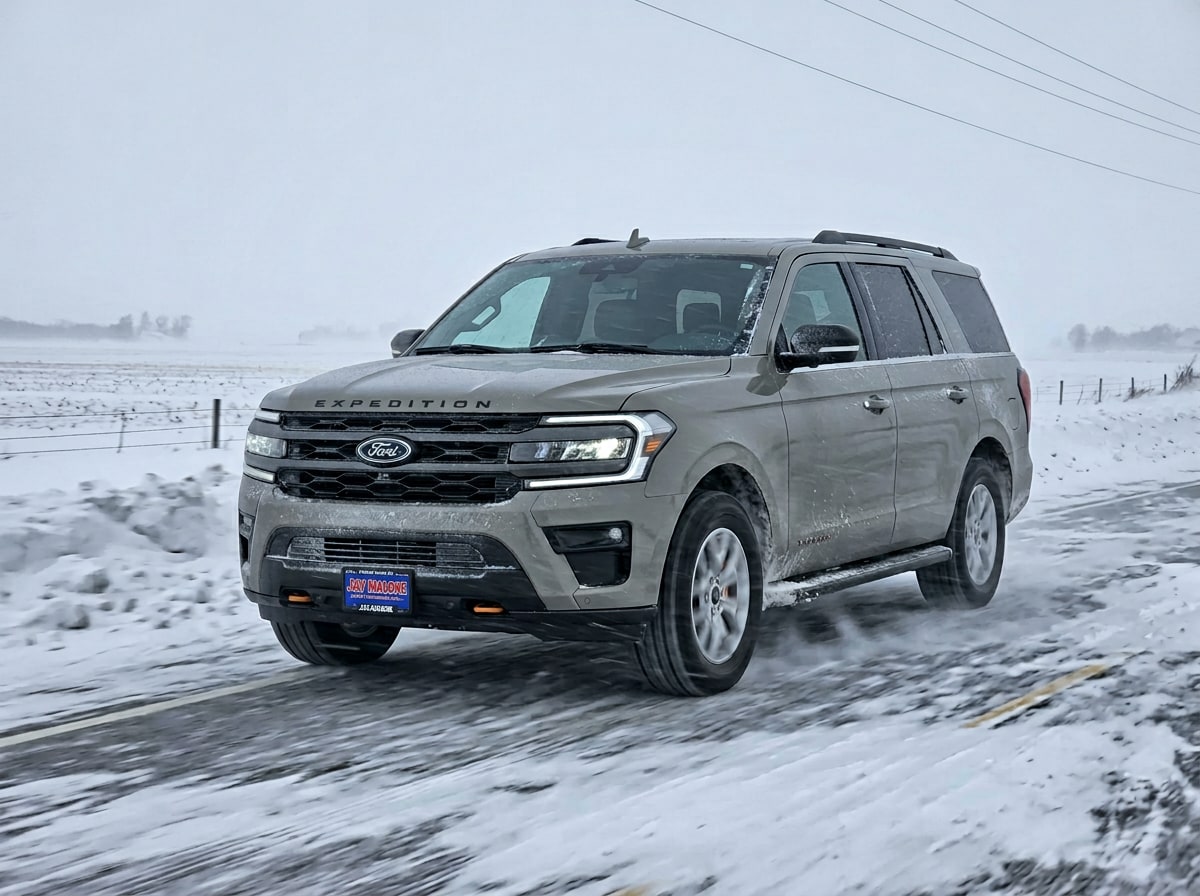
The 2026 Ford Expedition® was built for the kind of family hauling that defines central Minnesota life — a fishing boat to Belle Lake on Saturday, a pop-up camper to a state park on Sunday, the side-by-side trailer to a hunting lease in November, and the kids’ gear plus grandparents on the long drives in between. Available max towing of up to 9,600 lbs when properly equipped puts the Expedition in the upper end of the full-size SUV segment. Pro Trailer features standard with Ford Co-Pilot360® 2.0 make towing genuinely easier than it used to be. This guide walks through everything Expedition buyers need to know about towing capability, what packages and configurations matter most, and which trim setup fits the kind of trailers central Minnesota families actually pull.
On This Page
The 2026 Expedition is rated for available max towing of up to 9,600 lbs when properly equipped — meaning the trim, drivetrain, axle ratio, and packages have to all line up to hit that figure. For most buyers, the headline number is comfortably more than they actually need. For some, it’s the deciding factor.
What “properly equipped” means in practice:
One specific length-based detail: The Expedition MAX 4x2 Active gets a 300-pound towing capacity bonus over the standard-length 4x2 Active — rated to tow up to 6,300 lbs versus 6,000 lbs in the standard wheelbase. The longer wheelbase improves trailer stability, and Ford rates accordingly. For 4x4 trims with HDTT, the standard and MAX configurations have similar max ratings.
For trim-specific tow ratings: Ford publishes detailed tow capacity charts in the model-year Towing Guide, and the actual rating for a specific configuration depends on engine, drivetrain, axle, packages, optional equipment, and weight distribution. For exact figures on the configuration you’re considering, give us a call at the Hutchinson dealership and we’ll pull the specific rating from Ford’s towing guide.
The Heavy-Duty Trailer Tow Package (HDTT) is the towing-focused equipment bundle that turns the Expedition from a capable family hauler into a serious tow vehicle. It’s standard on Tremor, Platinum, and King Ranch trims, and optional on Active 4x4.
What’s included with HDTT:
What’s NOT in HDTT but worth knowing about:
If you tow regularly, ordering Active 4x4 with HDTT is the budget path to the same towing capability as a Platinum or King Ranch. The trim differences are about luxury equipment, not towing hardware.
Two Ford-proprietary trailer-handling features that are genuinely useful, and both are standard on every retail Expedition trim as part of Ford Co-Pilot360 Assist 2.0.
Pro Trailer Hitch Assist automatically guides the SUV in reverse to align the hitch ball with the trailer coupler. Particularly useful when you’re hooking up alone — instead of getting out three or four times to check ball-to-coupler alignment, the system uses the rear camera to track the coupler and steers the SUV directly underneath it. Works in tight spaces (driveways, narrow boat launches) where there’s no room for a spotter. After the system aligns, you put the SUV in park, drop the coupler, and you’re hooked up.
Pro Trailer Backup Assist reverses the steering inputs you use when backing a trailer. Trailer backing is one of the hardest skills to learn for new SUV-and-trailer owners — the inverse-steering relationship is counterintuitive. With Pro Trailer Backup Assist:
Why this actually matters: backing a trailer into a narrow boat launch ramp at first light, threading a trailer between trees on a deer lease, or backing a camper into a tight parking spot at a state park become substantially less stressful. For new towers, the system removes the steepest part of the trailer-handling learning curve. For experienced towers, it’s a useful tool when you’re tired or when conditions are tricky — it’s genuinely faster and more accurate than freehanding for most non-experts.
BLIS with Trailer Coverage extends the blind-spot detection zone behind the trailer being towed. Standard radar-based BLIS only covers the SUV’s blind spots; with Trailer Coverage, the system extends the detection zone behind the trailer, so vehicles approaching from the rear-quarter angle while you’re towing show up correctly. This is part of Co-Pilot360 Assist 2.0, standard on every retail trim.
Both available engines — the standard 3.5L EcoBoost V6 (400 hp) and the 3.5L EcoBoost V6 High-Output (440 hp / 510 lb-ft) — pair with the same 10-speed SelectShift® automatic transmission and can be configured with the Heavy-Duty Trailer Tow Package and 3.73 axle. The max tow rating doesn’t change between the two engines.
Where the High-Output engine matters for towing:
Where the standard 3.5L is plenty:
The HO engine is available on:
If towing is a major priority and you want the HO engine’s capability without going Tremor, the Platinum with Stealth Performance or Platinum Ultimate is the configuration. King Ranch uses the standard 400-hp engine.
Engine power and tow rating are only part of the towing equation. The Expedition’s stability and handling features are equally important — especially in the kind of weather and road conditions central Minnesota presents.
Trailer Sway Control is standard on every trim. Uses the SUV’s electronic stability control system to detect trailer sway and apply brake force individually to specific wheels to dampen the sway and prevent it from escalating. Trailer sway typically starts at highway speeds when crosswinds, drafts from passing semis, or uneven loading destabilizes the trailer. The system works automatically — you don’t do anything; you just feel the SUV applying brake corrections as needed.
4-Wheel Independent Suspension with Multilink Independent Rear Suspension is standard on Platinum and higher. The independent rear suspension handles trailer tongue weight more compliantly than a solid rear axle would — the SUV doesn’t pitch as much when you load up the tongue, and ride quality stays better when you’re towing.
Fully Boxed Frame is the structural foundation of the Expedition — same body-on-frame construction Ford uses on the F-150 and Super Duty. The frame is designed to handle towing loads without flexing, which translates to a more stable, more controlled feel with a trailer behind you.
Continuous Controlled Damping (CCD) Suspension is available on Platinum (with Stealth Performance or Platinum Ultimate Package). The active damping system automatically adjusts shock firmness based on conditions — firming up when you’re towing or carrying a heavy load, softening for everyday driving. CCD is genuinely useful for buyers who tow a meaningful percentage of their miles.
Selectable Drive Modes including Tow/Haul are standard on every 4x4 trim. The Tow/Haul mode adjusts transmission shift points to hold lower gears longer (better engine braking on descents, more responsive throttle), changes throttle response curves, and adjusts other drivetrain parameters specifically for towing.
Auto Stop-Start with cold-weather logic. The auto stop-start system is standard, but it temporarily disables in cold weather to keep the cabin warm — meaning you don’t lose your heater when stopped at a light during a Minnesota January.
Some realistic guidance on common trailer types and how the 2026 Expedition handles them, when properly equipped with HDTT and the right axle ratio. For exact tow ratings on your specific configuration, call us — we’ll pull the figures from Ford’s towing guide.
Aluminum fishing boats and small bass boats (1,500 to 3,500 lbs). Easy work for any Expedition with HDTT. The Active 4x4 with HDTT handles this range comfortably. Even the base 4x2 Active (without HDTT) handles a smaller fishing boat at the lower end of the range.
Mid-size pontoons and bass boats (3,500 to 5,500 lbs). Properly equipped Expedition handles this range well. HDTT and 4x4 are the right configuration. The standard 3.5L is plenty; the High-Output engine adds acceleration headroom but isn’t required.
Larger pontoons, ski boats, and small fishing boats with extras (5,500 to 7,500 lbs). Properly equipped Expedition handles this range. Heavy-Duty Trailer Tow Package becomes more important here — the integrated trailer brake controller is something you’ll appreciate at this weight. Both engines work; the HO adds comfort margin on hills.
Side-by-side trailers, double-stacked snowmobile trailers (3,000 to 6,000 lbs). Easy for a properly equipped Expedition. The trailer’s aerodynamic profile (typically a flat-fronted enclosed trailer) creates more drag than its weight suggests, but the Expedition handles it without strain.
Pop-up campers (1,500 to 3,500 lbs). Easy work for any Expedition. Even Active 4x2 without HDTT handles a typical pop-up. For rural cabin or campground access roads with steep grades, 4x4 is worth having.
Travel trailers (3,500 to 6,500 lbs). Properly equipped Expedition handles this range well. Heavy-Duty Trailer Tow Package and 4x4 are the right setup. For larger travel trailers approaching the upper end of the range, the High-Output engine adds meaningful comfort. Trailer length and aerodynamic profile start to matter at this weight — longer trailers create more sway potential and more wind drag.
Larger travel trailers and small fifth-wheels (6,500 to 9,000 lbs). Within the Expedition’s capability when properly equipped, but you’re into the territory where exact tow rating matters. Need to verify the specific configuration meets the trailer’s loaded weight (gross trailer weight, not dry weight). The High-Output engine and HDTT become more important. For travel trailers approaching the 9,600-lb available max, you want every advantage — HO engine, HDTT, 4x4, the 3.73 axle ratio, and (if budget allows) Continuous Controlled Damping.
Horse trailers (varies wildly). Two-horse bumper-pull trailers loaded with horses typically run 4,000 to 7,000 lbs. Three- and four-horse trailers run substantially heavier, especially with living quarters. Most two-horse trailers are well within the Expedition’s capability when properly equipped. Larger horse trailers with multiple horses or living quarters may require checking the specific tow rating against the trailer’s loaded weight — some configurations may exceed the Expedition’s rating, in which case you’re looking at an F-150 or F-250 instead.
Larger fifth-wheels and Class A motorhome dinghies. Outside the Expedition’s typical capability for fifth-wheels (which require a fifth-wheel hitch in a pickup bed). For dinghy duty behind a motorhome, the Expedition’s two-speed automatic 4WD with Neutral Towing Capability (part of HDTT) makes it flat-towable behind a Class A or Class C.
Some specific scenarios from buyers we’ve sold to over the years:
Boat to Belle Lake or Stahls Lake. A 16-foot Lund or similar with a 90-hp outboard runs about 2,500 lbs loaded with gas, gear, and a couple of passengers’ weight. Even a base Active 4x2 handles this without breaking a sweat. The Pro Trailer Hitch Assist makes solo launching at smaller MN lakes much easier.
Pontoon to Mille Lacs. A 22-foot pontoon with a 150-hp outboard runs about 4,500 to 5,500 lbs loaded. Active 4x4 with HDTT or any higher trim handles this easily. The longer drive (around 90 minutes from Hutchinson) is where BlueCruise (if equipped) makes the trip up and back substantially less tiring.
Side-by-side trailer to a deer lease. Enclosed trailer with two side-by-sides plus gear typically runs 4,000 to 6,000 lbs. Properly equipped Expedition handles this comfortably. The deer lease access road often involves gravel or unmaintained two-tracks — 4x4 with Heavy-Duty Trailer Tow is the right setup. Tremor is overkill unless you’re also using the off-road capability for the lease itself.
Pop-up camper to a state park. Most pop-up campers run 1,500 to 3,500 lbs. Easy work. Active 4x2 handles them; Active 4x4 is better for state park gravel roads and rougher access. For the camping itself, the Expedition’s 5G Wi-Fi hotspot (1-year included) keeps kids entertained while you set up.
Larger family travel trailer to the Boundary Waters or Black Hills. 6,000 to 8,500 lbs. Properly equipped Expedition handles this with HDTT, 4x4, and (preferably) the High-Output engine for the longer climbs. Tremor or Platinum with Stealth Performance or Platinum Ultimate Package — or Platinum standard with Heavy-Duty Trailer Tow if you don’t need the HO engine. Trip from Hutchinson to the Black Hills is around 8 hours one way; BlueCruise on the highway portions makes it substantially less tiring.
Horse trailer for 4-H or county fair. A two-horse bumper-pull loaded with horses runs about 5,000 lbs. Standard county-fair towing distances aren’t long, but stability and Pro Trailer Backup Assist matter when you’re backing into a stall or showgrounds parking area. Active 4x4 with HDTT or any higher trim handles this without strain.
Snowmobile trailer in winter. Two-snowmobile open trailer typically runs 1,500 to 2,500 lbs. Easy. Even the base Active handles this. What matters more is the 4x4 system and Slippery drive mode for the snowy launch areas and parking lots at trailheads.
Towing is half the Expedition’s purpose. The other half is hauling people and the gear that comes with them. Eight-passenger seating is standard with a second-row bench; seven-passenger with second-row Captain’s Chairs. Either way, the third row is genuinely usable for adults — not just kids.
Cargo space considerations:
Real family-of-eight scenarios:
For more detail on the standard vs. MAX decision specifically — including how cargo space changes for full-vehicle road trips — see our 2026 Expedition vs. Expedition MAX guide.
If maximum towing capability is your top priority, here’s how the trims rank:
Tremor. 440-hp High-Output engine standard, Heavy-Duty Trailer Tow standard, 4x4 only, electronic-locking rear differential. The locking diff matters less for road towing than it does for off-road, but it’s a backup feature for getting a trailer unstuck from a muddy boat launch or icy lease access. Standard length only — if MAX cargo capacity matters as much as towing, look at Platinum or King Ranch instead.
Platinum with Stealth Performance Package or Platinum Ultimate Package. 440-hp High-Output engine, Heavy-Duty Trailer Tow standard, 4x4 only, optional Continuous Controlled Damping suspension (with these specific packages). Available in standard length or MAX. The closest the standard Expedition gets to Tremor-level powertrain capability without the off-road tuning. For buyers who tow regularly and want the additional power and luxury equipment, this is the configuration.
King Ranch. Standard 400-hp engine (no HO option), Heavy-Duty Trailer Tow standard, 4x4 only, premium Del Rio leather and Mesa Antique interior. Excellent towing capability and luxury equipment in either standard or MAX length. The 22-speaker B&O Unleashed audio is genuinely worth it on long highway tow trips. King Ranch MAX is a popular configuration for buyers who use the Expedition as a primary highway-mile family-and-towing vehicle.
Platinum (without HO packages). Standard 400-hp engine, Heavy-Duty Trailer Tow standard, 4x4 only. The standard Platinum configuration handles most family-camping and recreational towing scenarios well. Good value if you don’t need the HO engine.
Active 4x4 with HDTT. Standard 400-hp engine, Heavy-Duty Trailer Tow as a factory option (highly recommended for any active tower), 4x4. Same towing capability as Platinum with the standard engine. The most affordable path to serious Expedition towing capability.
Active 4x2 (with or without HDTT). Lower towing rating than 4x4 configurations. Best for buyers who tow occasionally on flat terrain (most of MN) and don’t need 4x4 for the trailer access roads. The 4x2 Expedition MAX gets a 300-lb tow rating bonus over standard length 4x2.
A few practical suggestions if the Expedition is your first serious tow vehicle, or your first one in a while:
Get the integrated trailer brake controller. If you’re towing anything over about 3,000 lbs, the integrated controller is genuinely better than aftermarket. It’s factory-calibrated, integrates with the SUV’s ABS and stability systems, and gives you adjustable gain settings for different trailer weights. It comes with HDTT.
Use Tow/Haul mode every time you’re hooked to a trailer. Even if the trailer is light. Tow/Haul changes shift points and throttle behavior in ways that matter for trailer handling, and there’s no downside to having it engaged.
Practice with Pro Trailer Backup Assist before you need it. Spend 20 minutes in an empty parking lot with the trailer attached, getting comfortable with the knob-control system. The first time you use it should not be at a remote boat launch with people watching.
Don’t exceed the trailer’s tongue weight. Most travel trailers have a target tongue weight that’s 10-15% of the loaded trailer weight. Too little tongue weight (or worse, negative tongue weight) is what causes trailer sway. Pack heavier items toward the front of the trailer.
Check tire pressures monthly — trailer and tow vehicle. Underinflated tires are the #1 cause of blowouts during towing. Cold air (Minnesota winters) drops tire pressure substantially — a tire that’s 35 PSI in October will be 28-30 PSI in January.
Engine block heater is your friend. Especially on cold mornings before a long tow day, the block heater (option 41H) gets the engine to operating temperature faster, reduces wear on the engine, and gets your cabin heat up faster too. Plug in for 2-3 hours before you leave.
Watch your fuel range. Towing reduces fuel economy substantially. Plan fuel stops based on towing range, not normal-driving range. Some MN highway routes have long stretches between stations — fill up before you need to.
Use Slippery mode on icy launch ramps. Boat launches with ice or moss are where AWD systems show their limits. Engage Slippery before you back the trailer in — it changes throttle response and traction control thresholds in ways that help you maintain control instead of spinning a wheel.
For more on all the technology that helps with towing — including BlueCruise, Co-Pilot360, and Pro Trailer features — see our 2026 Expedition technology and BlueCruise guide.
Key Takeaways
Available max towing of up to 9,600 lbs when properly equipped. The exact rating for your specific configuration depends on trim, drivetrain, axle ratio, packages, and optional equipment. For the exact figure on the Expedition you’re considering, give us a call — we’ll pull the specific tow rating from Ford’s towing guide.
Probably not, depending on your boat. The standard 400-hp 3.5L EcoBoost handles most central Minnesota recreational towing — fishing boats, pontoons, ski boats, and most travel trailers within the Expedition’s tow rating. The High-Output (440 hp / 510 lb-ft) adds acceleration, hill-climbing power, and headroom at altitude. For most flat-terrain MN towing, the standard engine is plenty. For long mountain trips or heavy travel trailers approaching the Expedition’s max rating, the HO is worth the upgrade.
If you’re going to tow anything regularly, yes. HDTT adds the Integrated Trailer Brake Controller (essential for trailers with electric brakes), the larger engine radiator (handles sustained tow loads better), the Two-Speed Automatic 4WD with Neutral Towing capability (matters if you ever flat-tow behind a motorhome), and the 3.73 axle ratio (the right gearing for towing). It’s a worthwhile upgrade for any Active 4x4 buyer who tows even occasionally. Active 4x4 with HDTT delivers the same towing capability as a Platinum with the standard engine, at a lower starting price.
You turn a knob on the dashboard left or right to indicate which direction you want the trailer to go. The Expedition handles the steering automatically — the steering wheel itself rotates as the system applies the correct inverse-steering inputs. You handle gas and brakes; the system handles steering. Works at speeds up to about 5 mph in reverse. The result: trailer backing becomes substantially easier, especially for new towers. Standard with Co-Pilot360 Assist 2.0 on every retail trim.
No. Fifth-wheel trailers require a fifth-wheel hitch installed in a pickup truck bed — the hitch attaches over the rear axle of the truck. The Expedition is an SUV without a bed, so it can’t accommodate a fifth-wheel hitch. For fifth-wheel towing, you’re looking at an F-150 or F-250 instead. The Expedition can pull bumper-pull travel trailers, pop-ups, boats, ATV trailers, side-by-side trailers, and similar trailers up to its rated towing capacity.
It’s a meaningful upgrade for buyers who tow a substantial percentage of their miles. CCD is available on Platinum with the Stealth Performance Package or Platinum Ultimate Package. The active damping system automatically firms up the shocks when you’re towing or carrying a heavy load, then softens for everyday driving. The result is a more controlled feel with a trailer behind you, and a more comfortable ride empty. If towing is a major use case, CCD is genuinely worth it. If you tow only occasionally, the standard suspension is plenty.
In one specific case, yes — the 4x2 MAX Active gets 300 pounds more towing capacity (6,300 lbs vs. 6,000 lbs) than the standard-length 4x2 Active. The longer wheelbase improves trailer stability, and Ford rates accordingly. For 4x4 trims with Heavy-Duty Trailer Tow, max ratings are similar between standard and MAX configurations. The MAX’s longer wheelbase generally provides better trailer stability at any tow rating — especially with longer trailers — but the spec-sheet maximum is comparable.
If you have a specific trailer in mind — the family camper, the bass boat, the horse trailer, the side-by-side rig — come down to Hutchinson and we’ll help you spec the right Expedition configuration for it. We can pull exact tow ratings from Ford’s towing guide for any trim and option combination, and we’ll set you up with a real test drive that includes the kind of roads you’ll actually tow on.
If we don’t have your exact configuration in stock, we’ll either pull one from another dealer at no extra charge or place a factory order through Ford. Same price either way — that’s how we’ve operated since 2005.
About the Author
I’m Jordan Malone-Forst, Assistant General Manager at Jay Malone Motors in Hutchinson, MN. I’m proud to be part of the family business my dad Jay started in 2005 — and even prouder to serve the community I grew up in. When I’m not at the dealership, you’ll find me involved with the Hutchinson Ambassadors and Chamber of Commerce. If you have questions about any Ford vehicle or want to talk through your options, reach out — I’d love to help.