💵
Value My Car → We Buy Cars — Even If You Don’t Buy From Us.
Get a real offer on your vehicle in minutes. No obligation, no pressure.


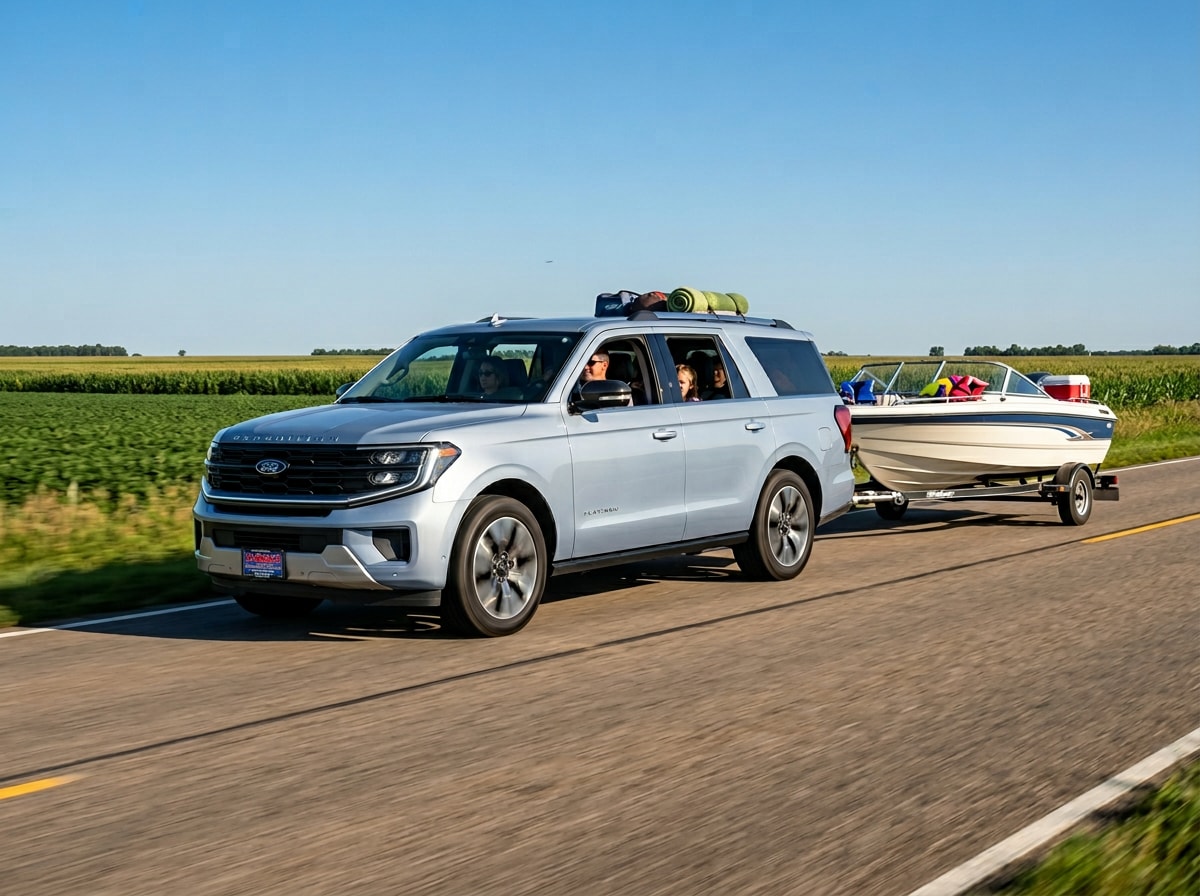
The 2026 Ford Expedition® is offered in two body lengths — standard and the longer Expedition MAX. The difference between them is bigger than the spec sheet suggests. The MAX adds up to 11.8 inches of additional cargo length and up to 37.4 cubic feet of cargo space behind the third row, which translates into a meaningfully different vehicle when you actually load it up with passengers and gear. For some central Minnesota families, the MAX is a clear upgrade. For others, the standard length is plenty. This guide walks through the actual differences, who each length is built for, and how to decide which one fits your driveway, your garage, and your life.
On This Page
Before the deep-dive, the short answer for buyers who don’t want to read the whole post:
Get the standard-length Expedition if: you don’t regularly fill the third row with passengers AND luggage simultaneously, you want easier maneuvering in tight parking lots, your driveway and garage are sized closer to a typical full-size SUV, you want the Tremor (which is standard length only), or your day-to-day driving involves narrow gravel roads and small downtown lots.
Get the Expedition MAX if: you regularly carry seven or eight people on family trips, you take longer family vacations where everyone packs full luggage, you tow a camper or boat AND haul gear inside, you have the garage and driveway space, or your road trips currently involve a roof box because the cargo area runs out of room.
Both are good vehicles. The differences come down to how you actually use it.
The Expedition MAX shares the same width, height, front and rear styling, and overall stance as the standard-length Expedition. What’s different is the wheelbase — the distance between the front and rear axles — and the rear overhang behind the third row. The result is up to 11.8 inches of additional cargo length behind the third row, plus a longer wheelbase that adds roughly that same amount to the overall vehicle length.
For perspective: think of the difference like adding the length of a standard sheet of letter-size paper plus a few inches to the back of the SUV. From the driver’s seat, the change is barely perceptible — the dashboard, sightlines, and mirror positions are identical. From the back of the cargo area, it’s a substantial difference. Loading a fully packed cooler, two folded camp chairs, a cooler full of beverages, and a stroller behind the third row goes from “tight” in standard length to “easy” in MAX.
From outside the vehicle, the visual difference is most obvious from the side, where the longer wheelbase changes the proportions slightly. From the front or rear, both vehicles look essentially identical.
Cargo space is the single biggest reason buyers choose MAX. Specifically: cargo space behind the third row, where the standard Expedition is meaningfully tight when all three rows are occupied.
Cargo behind the third row: The MAX adds up to 37.4 cubic feet of cargo space behind the third row compared to the standard wheelbase. That’s the difference between “the kids fit but the luggage rides on top of their feet” and “everyone has space and the cargo area is genuinely useful.”
Cargo with the third row folded: Both lengths have substantial cargo space with the third row folded, but the MAX’s longer floor accommodates longer items. If you ever load lumber, kayaks, fishing rods, hockey sticks, or skis inside the vehicle (rather than on a roof rack), the MAX’s longer floor is more useful.
Cargo with all rows folded: Both lengths offer large total cargo volume, but the MAX’s extra floor length means you can carry meaningfully longer items without the rear hatch having to remain open. For buyers who occasionally use their SUV as a part-time pickup — helping move furniture, hauling building materials — the MAX’s extra length is genuinely useful.
Real-world central Minnesota scenarios where the cargo difference matters:
A common assumption is that the MAX adds third-row passenger room. The reality is more nuanced.
The longer wheelbase doesn’t add a meaningful amount of legroom for third-row passengers. Most of the additional length goes into the cargo area behind the third row. What changes is the third row’s usability when the cargo area is also full of stuff. In the standard-length Expedition, packing the cargo area to the brim means the third row’s seatback is practically up against the cargo. In the MAX, the third row can be fully reclined while the cargo area still holds substantial gear.
For families that regularly use the third row with kids in booster seats:
Both lengths offer the same available second-row Captain’s Chairs (which give a center aisle for easier third-row access), the same available power-folding third row, and the same Third Row Flexible Seating 40/20/40 option (option 21Y) on Active Touring (202A). All trim level configurations and seating arrangements are available in both standard and MAX length. The MAX doesn’t add new seating configurations — it just gives the existing seating more breathing room when the cargo area is also full.
MAX (extended length) is available on three of the four retail trims. Tremor is the exception — it’s standard length only.
Active — available in both lengths, with both 4x2 and 4x4 drivetrain options. Body codes are U1H/U1J for standard length and K1H/K1J for MAX (the K-prefix is the MAX designation across the lineup).
Tremor — standard length ONLY (body code U1R). 4x4 only. The Tremor’s modified suspension, 33-inch all-terrain tires, fuel tank skid plates, and Rock Crawl mode are tuned specifically around the standard wheelbase. If you want the off-road capability of the Tremor, you’re committing to standard length.
Platinum — available in both lengths (body codes U1M for standard, K1M for MAX), 4x4 only. Both lengths can be ordered with the Driver’s Package, Stealth Appearance, Stealth Performance, or Platinum Ultimate Package.
King Ranch — available in both lengths (body codes U1P for standard, K1P for MAX), 4x4 only. The MAX is a popular configuration for King Ranch buyers who use the Expedition as a primary highway-mile family vehicle.
The trade-off if you want both off-road capability AND maximum cargo: there isn’t a Tremor MAX. Your options are:
For most buyers who don’t actually rock-crawl or run technical trails, an Active 4x4 MAX or Platinum 4x4 MAX delivers the cargo space and the snowy-back-roads capability without the Tremor’s off-road-tuned (and somewhat noisier) tires.
Yes — in a small but interesting way for one specific configuration.
The 4x2 MAX Active gets a 300-pound towing capacity bonus over the standard-length 4x2 Active — rated to tow up to 6,300 lbs versus 6,000 lbs in standard length. The longer wheelbase improves the vehicle’s stability with a trailer, and Ford rates accordingly.
For the rest of the lineup — 4x4 Active, Platinum (both lengths), King Ranch (both lengths) — max towing capacity is similar in standard and MAX configurations. Available max towing of up to 9,600 lbs when properly equipped is the headline figure for the lineup.
Heavy-Duty Trailer Tow Package is standard on Tremor, Platinum, and King Ranch. Optional on Active 4x4. Includes the integrated trailer brake controller, two-speed automatic 4WD with neutral towing capability (4x4 only), and the 26mm engine radiator (28mm on Tremor).
What length helps with towing in real-world MN use: A longer wheelbase generally translates to a more stable platform when towing — the trailer’s pivot point is farther back, which reduces the leverage effect of trailer sway. For buyers towing larger family campers or larger boats, MAX is the slightly more stable choice. For most central Minnesota towing — fishing boats, pop-ups, side-by-side trailers, ATV trailers — the difference is small enough that other factors (engine, axle ratio, packages) matter more than length.
Our complete towing and family hauling guide for the 2026 Expedition is coming soon and will be linked here when published.
Length is the only meaningful structural difference between standard and MAX. Almost everything else is identical.
Same regardless of length:
In other words: the choice between standard and MAX is fundamentally a choice about cargo space and length-related driving characteristics. It’s not a choice between “basic” and “loaded” or “efficient” and “capable.” A King Ranch MAX has the same luxury equipment as a King Ranch standard. An Active MAX has the same family-friendly setup as an Active standard.
The MAX’s longer wheelbase changes how the vehicle behaves in a few situations. None of these are dealbreakers — just things to know going in.
Turning radius is wider in MAX. Tight U-turns and parking lot maneuvers require a bit more space. In a typical big-box parking lot or on a normal city street, this is barely noticeable. In a tight downtown space or a small gas station, you’ll feel the difference — you’ll need to turn the wheel a bit more or back-and-forth one extra time.
Parking is harder in tight spots. Both lengths are big SUVs — the MAX is bigger. Standard parallel parking spaces accommodate the standard-length Expedition without much room to spare. The MAX often requires either a long parallel space or two angled spaces. Drive-through banks, certain older drive-through restaurants, and some downtown parking ramps may have height or length restrictions worth checking before you commit. The 360-Degree Camera (standard with Co-Pilot360 Active 2.0) helps significantly in tight spots regardless of length.
Garage fit. Standard 24-foot garages handle the MAX, but they don’t leave much room in front or behind. Older garages built before the era of full-size SUVs may not fit a MAX at all. Measure your garage carefully — specifically the door clearance and the depth from door to back wall — before ordering. We’ve had customers measure tight and end up parking the MAX in the driveway through winter, which works but isn’t ideal.
Highway and freeway driving. The MAX is genuinely more stable than standard length on the highway, especially when towing or with a full passenger load. The longer wheelbase smooths out road imperfections, reduces pitch over rolling terrain, and feels planted at highway speeds. For long road trips on US-12, MN-15, or interstates, MAX is the more comfortable highway vehicle.
Backing into driveways and trailers. The longer wheelbase makes the MAX a touch slower to respond to steering inputs in reverse — the trade-off is that small steering corrections are less likely to over-rotate. Pro Trailer Backup Assist (standard with Co-Pilot360 2.0) helps significantly with trailer backing on either length.
Fuel economy. Both lengths run the same engines and transmissions. Differences in fuel economy between standard and MAX are typically small — the MAX’s additional weight has a marginal impact on the highway, slightly more in stop-and-go driving. Ford has not yet published final EPA-rated fuel economy figures for the 2026 Expedition; we’ll update this when those are confirmed.
A few practical points for central Minnesota buyers specifically:
Older garages. A meaningful number of central Minnesota homes were built before 1980 and have garages sized for the cars of that era. We’ve had customers find that a MAX simply won’t fit their existing garage. If your home was built before 1990 and has an attached garage, take a tape measure to it before ordering the MAX. Door height clearance also matters — Expeditions with the Tremor’s 33-inch tires and platform running boards are taller than standard configurations.
Gravel roads and tight rural driveways. If your daily commute or weekend cabin involves narrow gravel township roads, a MAX is fine but you’ll feel the longer wheelbase in tight turns. Standard length is more nimble in those scenarios.
Lake cabin and boat launch access. Tight launch ramps with limited maneuvering space are easier in standard length. If you regularly back trailers into ramps with cars parked or trees close to the water, the standard wheelbase is more forgiving.
Winter driveway and snow piles. Both lengths are heavy SUVs that handle snow well. Standard length is slightly easier to navigate around snow piles in residential driveways. MAX requires a touch more clearance to back into a typical residential driveway.
Long road trips. Minnesota families travel — cabin trips up north, family vacations to the Boundary Waters or out West, college trips to Twin Cities campuses, summer trips to the Black Hills or Yellowstone. For trips longer than a long weekend with a full passenger load, MAX is meaningfully better. The cargo space difference shows up exactly when you need it most.
Some specific buyer scenarios from the Hutchinson sales floor:
Family of four with one in a car seat. Standard length. The third row gets occasional use; the cargo area is plenty for a family of four. MAX is overkill for daily life and harder to park downtown.
Family of five or six with kids in boosters. Either works, depends on travel patterns. If most of your family driving is in-town and short trips, standard length is plenty. If you take long road trips with the third row occupied, MAX gives you the cargo space to bring everyone’s stuff comfortably.
Family of seven or eight that travels regularly. MAX. The cargo space difference shows up exactly when you’re packing for a multi-day trip with a full vehicle.
Empty-nesters who tow a camper. Either, depending on camper size and how often grandkids ride along. For a smaller camper and weekend trips with a couple grandkids, standard length is plenty. For a larger camper, a Class C-sized travel trailer, or regular trips with all the grandkids, MAX is the more comfortable highway vehicle.
Hunting and outdoor sportsmen. Tremor (standard length only) for serious off-road use. Otherwise, standard length for the gravel-road maneuverability. MAX makes sense if you regularly haul hunting parties of 6-8 people with all their gear — otherwise the off-road benefits don’t outweigh the size.
Buyers using the Expedition as a part-time pickup. MAX. The longer cargo floor handles longer items — lumber, kayaks, fishing rods, hockey sticks — without the rear hatch having to stay open. If you regularly help neighbors move or haul materials for projects, MAX is the more useful vehicle.
Buyers with smaller garages. Standard length, definitely. A MAX in a tight garage means living with extremely limited clearance and a frustrating daily routine.
Highway commuters. Standard length is plenty. Both lengths are stable on highways — the MAX’s slight stability advantage doesn’t justify the parking and maneuverability trade-offs for commute-only use.
The buyer who can’t decide. Test drive both. The size difference reads on the spec sheet but lives in the test drive. Sit in the third row of each, load a few imaginary suitcases into the cargo area, then drive both through a typical day’s errands — the right length usually becomes obvious within an hour.
For a deeper look at trim choices on each length, see our 2026 Ford Expedition trim levels guide. For the Tremor (standard length only), see our 2026 Expedition Tremor deep-dive.
Key Takeaways
The MAX adds up to 11.8 inches of additional cargo length behind the third row and a similar amount to the overall vehicle length. The width and height are essentially the same as standard length.
Not meaningfully. Most of the additional length goes into the cargo area behind the third row, not into the seating area. What changes is the third row’s comfort when the cargo area is also full — in standard length, packing the cargo area to the brim means the third-row seatback is right against the cargo. In MAX, the third row can be fully reclined while the cargo area still holds substantial gear.
No. Tremor is standard length only. The Tremor’s modified suspension, 33-inch all-terrain tires, and off-road tuning are designed for the standard wheelbase. If you want both off-road capability and maximum cargo space, your alternatives are Active 4x4 MAX, Platinum 4x4 MAX, or King Ranch 4x4 MAX with Heavy-Duty Trailer Tow — all capable of handling most central Minnesota off-road needs without the Tremor’s specific hardware.
In one specific case, yes — the 4x2 MAX Active gets a 300-pound bonus over the standard 4x2 Active (6,300 vs. 6,000 lbs). For 4x4 trims with Heavy-Duty Trailer Tow, max ratings are similar between standard and MAX. The MAX’s longer wheelbase generally provides slightly better trailer stability, especially with larger trailers, but the spec-sheet rating is comparable between the two lengths in most configurations.
Most modern garages built after 1990 will accommodate a MAX, but it’s worth measuring carefully — specifically the door clearance and the depth from door to back wall. Standard 24-foot garages typically work but don’t leave much room. Older garages may not fit at all. We’ve seen customers measure their garage too tight and end up parking the MAX in the driveway, which works in Minnesota with good winterization but isn’t ideal. If garage fit is uncertain, take a tape measure to your garage before ordering — we can also bring an Expedition out for you to test the fit before you commit.
Yes, in tight spots. Both lengths are big SUVs — the MAX is bigger. In typical big-box parking lots, the difference is barely noticeable. In tight downtown spots, drive-through restaurants with narrow lanes, and parking ramps with stricter length limits, you’ll feel the difference. The 360-Degree Camera (standard with Co-Pilot360 Active 2.0) helps significantly — it’s available on Active Touring, Tremor, Platinum, and King Ranch.
Slightly. Both lengths run the same engines and transmissions, so the powertrain is identical. The MAX’s additional weight has a marginal impact on fuel economy — typically smaller on the highway, slightly more in stop-and-go driving. Ford has not yet published final EPA-rated fuel economy figures for the 2026 Expedition. We’ll update this guide when those numbers are confirmed.
The MAX typically adds around $3,000–$4,000 to the MSRP compared to the same trim in standard length — the exact amount varies by trim, equipment group, and current Ford pricing. For a current quote on any configuration, call us at (320) 587-4748 or browse our 2026 Expedition inventory. We’ll pull exact numbers on any specific build.
Most 2026 Expedition factory orders have been arriving in 8–14 weeks from order confirmation, depending on trim, options, and Ford’s production schedule at the time. We’ll give you the current estimate when you order — production windows shift. Call us at (320) 587-4748 or stop in and we’ll check live availability for your configuration.
If you’re torn between standard and MAX, the best way to decide is to see both in person. We can usually have one of each on the lot, and a side-by-side test drive on US-7 or MN-15 makes the decision much easier than reading spec sheets. Bring a tape measure if you want to check garage clearance or trailer fit. Bring the kids if you want to test the third row. Bring whatever you’d normally pack for a road trip if you want to check cargo capacity.
If we don’t have your exact configuration in stock, we’ll either pull one from another dealer at no extra charge or place a factory order through Ford. Same price either way — that’s how we’ve operated since 2005.
About the Author
I’m Jordan Malone-Forst, Assistant General Manager at Jay Malone Motors in Hutchinson, MN. I’m proud to be part of the family business my dad Jay started in 2005 — and even prouder to serve the community I grew up in. When I’m not at the dealership, you’ll find me involved with the Hutchinson Ambassadors and Chamber of Commerce. If you have questions about any Ford vehicle or want to talk through your options, reach out — I’d love to help.