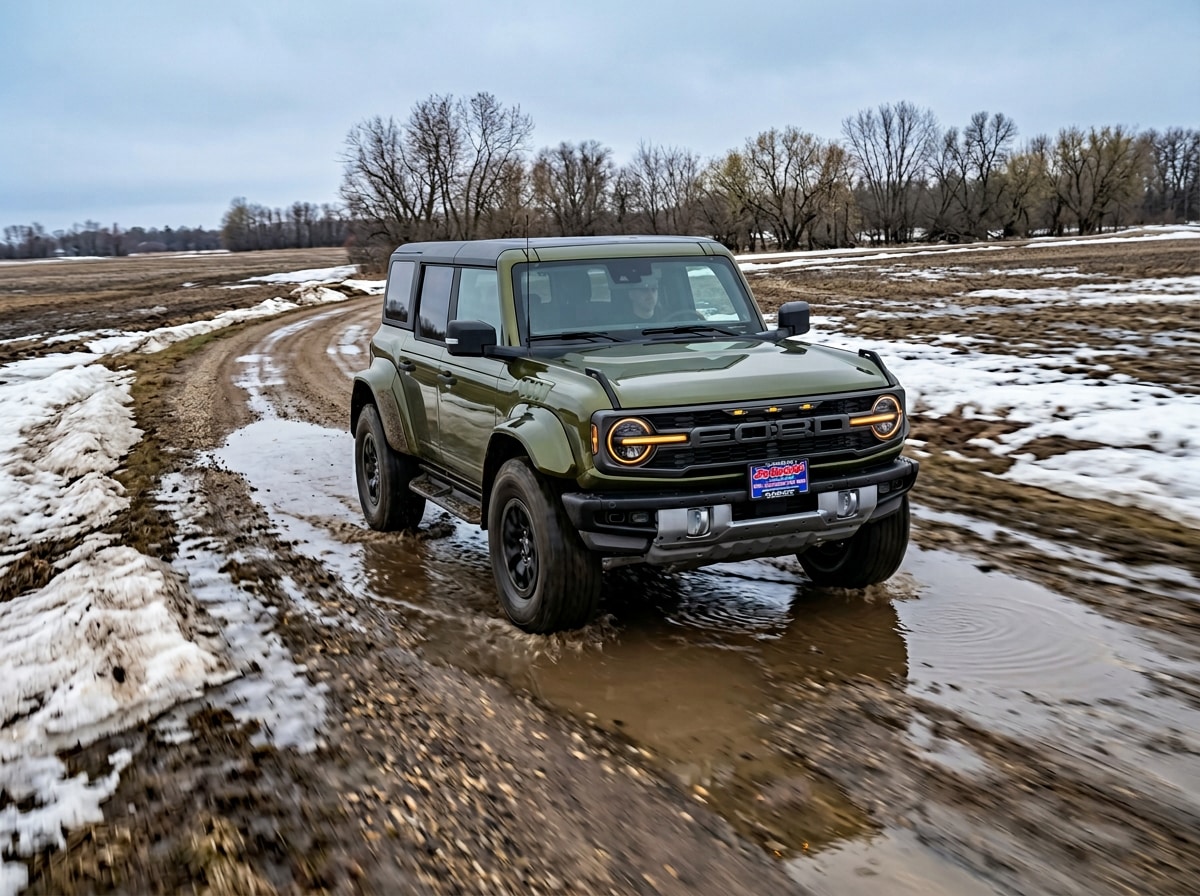
Central Minnesota winters punish vehicles. Sub-zero starts, salted highways, drifting county roads, parking lots that turn into hockey rinks by mid-January. The 2026 Ford Bronco® is one of the most winter-capable SUVs we sell at Jay Malone Ford — standard 4x4 across the lineup, available heated seats and steering wheel, optional engine block heater, and G.O.A.T. Modes® with a Slippery setting that’s genuinely useful on ice. This guide covers what makes the Bronco work in Minnesota winters, which features matter most for cold-weather driving, and how to set up your Bronco so January mornings stop being a problem.
4x4 vs. AWD — what the Bronco gives you that crossovers don’t
Every 2026 Bronco comes with real 4x4 — not all-wheel drive. This is the single biggest reason the Bronco handles Minnesota winters better than most crossover SUVs. Crossovers like the Ford Escape, Bronco Sport, or Toyota RAV4 use AWD systems that automatically shuffle power between the front and rear wheels based on slip detection. They work fine in moderate snow on plowed roads. But they don’t have low-range gearing, and they don’t mechanically lock the driveshafts together — both of which become important when the conditions get worse.
Two 4x4 systems on the 2026 Bronco:
Part-time selectable 4x4 (Base, Big Bend, Outer Banks, Heritage Edition without Sasquatch). You select 2H, 4H, or 4L manually. 2H is your everyday driving mode — rear-wheel drive, optimized for fuel economy and dry pavement. 4H locks the front and rear driveshafts together at normal gearing — for snow-covered roads, gravel, and unplowed driveways. 4L drops into low-range gearing — for getting unstuck, climbing steep snow drifts, or pulling a buddy out of a ditch.
Advanced 4x4 with Auto On Demand (Badlands, Raptor, and any trim with Sasquatch™ or Black Diamond™ Package). Adds a 4-Auto mode that you can leave engaged on dry pavement — the system automatically distributes power between front and rear axles based on conditions. This is the best setup for Minnesota winters specifically because you don’t have to think about it: pull out of the garage in 4-Auto in November and leave it there until April. The system handles wet, dry, snowy, and icy patches without driver input.
Why low range matters in winter. Low-range gearing multiplies engine torque dramatically — the truck can crawl through deep snow, up steep grades, or out of stuck situations at very low speeds with the throttle barely cracked open. AWD crossovers can’t do this. If you’ve ever been stuck in deep snow with an Escape or RAV4, you know the feeling: the wheels spin, the system gives up, and you’re calling for a tow. The Bronco’s low range and (with Sasquatch) electronic-locking differentials are what get you out instead of stuck.
For deeper coverage of how the 4x4 system works, see our 2026 Bronco off-road capability guide.
Slippery G.O.A.T. Mode and how it actually works
Slippery is one of the five G.O.A.T. Modes that’s standard on every 2026 Bronco trim. It’s the most useful winter feature you’ll never see advertised, and it makes a real difference on icy roads.
What Slippery mode does:
- Throttle response softens significantly — pressing the gas pedal halfway gives you noticeably less power than in Normal mode. This prevents wheel spin from a stop on ice or packed snow, where too much throttle would just spin the tires.
- Transmission starts in second gear from a stop (with the 10-speed automatic) — reduces torque at the wheels for smoother takeoff on slippery surfaces.
- Traction control becomes more aggressive — cuts power to slipping wheels faster than in Normal mode, redirecting torque to wheels with grip.
- Stability control thresholds tighten — the system intervenes earlier if the truck starts to slide, helping you maintain directional control.
In practice, Slippery mode turns the Bronco into a much more forgiving vehicle on ice. If you’ve been driving a manual-throttle Bronco for the first time on a January morning in Hutchinson, you’ll appreciate how it takes some of the “don’t spin the tires” load off your right foot. Set it once when you start the truck and forget it until the road clears.
A note on when NOT to use Slippery: deep snow on unplowed roads. In deep snow, you actually want some wheel spin to maintain momentum — that’s closer to Sand mode behavior, or just plain 4H with traction control off. Slippery is optimized for low-traction surfaces where you want maximum stability, not for plowing through drifts.
Cold starts — engine block heater, remote start, and scheduled start
Sub-zero mornings are hard on engines. Oil thickens, batteries lose capacity, and the engine takes longer to reach operating temperature. The Bronco offers three features that make winter starts dramatically better.
Engine block heater (option code 41H). An inexpensive factory option available on every Bronco trim. The block heater is a small electric heating element installed in the engine block that you plug into a standard 110V outlet overnight or in the morning. After a few hours of being plugged in, the engine, oil, and coolant are all pre-warmed — the truck starts immediately, the cabin warms up faster, and engine wear from cold starts drops significantly. For Minnesota buyers, we recommend this option to almost everyone. The cost is modest, and the benefit on a -20°F January morning is enormous.
Remote start. Included in the Mid Package on Big Bend and higher trims, with the 10-speed automatic transmission. Press a button on the key fob (or schedule from the Ford App) and the truck starts itself, runs the engine and climate control for the duration you set, and shuts off if you don’t enter. You walk out to a warm cabin, defrosted windshield, and pre-heated seats (if equipped).
Scheduled remote start via Ford App. Set the truck to start automatically at specific times — for example, every weekday at 7:15 AM. By the time you finish your coffee at 7:25, the cabin is warm, the windshield is clear, and the heated seats are ready. This is the feature most central Minnesota Bronco owners use every winter day. Schedule it once at the start of the season and forget it.
The combo we recommend for Minnesota: 10-speed automatic transmission + Mid Package + engine block heater. With those three together, you get scheduled remote start, heated seats, and a pre-warmed engine block. Walking out to your truck on a January morning becomes one of those small daily luxuries that’s hard to give up once you have it.
A note on the manual transmission: remote start works differently with the 7-speed manual and doesn’t support all of the Ford App’s scheduling features. If winter convenience is a priority, the 10-speed automatic is the better choice. If you specifically want the manual for the Granny Gear and the off-road feel, you’re trading the scheduled-start feature for that.
Heated seats, heated steering wheel, and other warm-comfort features
Heated front seats. Part of the Mid Package — optional on Big Bend, standard on Outer Banks, Badlands, Heritage Edition, Stroppe, and Raptor. The Bronco uses fast-acting seat heaters that warm up faster than the cabin air does, so you feel comfortable within a couple of minutes of starting the truck.
Heated steering wheel. Standard on Outer Banks, Badlands, Heritage Edition, Stroppe, and Raptor. Not available on Big Bend or Base. If you’ve never had a heated steering wheel, it’s one of those features that sounds like a luxury and turns out to be a daily necessity once you’ve experienced it — especially with leather steering wheels, which feel painfully cold to grip on a -10°F morning.
Dual-zone Electronic Automatic Temperature Control. Included in the Mid Package on Big Bend and higher. Lets the driver and front passenger set independent temperature targets — useful when one person runs hot and the other runs cold, which is most couples in winter.
Rear HVAC. Standard on the 4-door Bronco with the 10-speed automatic. The 2-door doesn’t offer rear HVAC. If you regularly carry rear-seat passengers and you live somewhere with real winters, the 4-door is meaningfully more comfortable.
Rear-window defroster and washer. Standard with any hard top. Not included with the soft top — if you’re running a soft top in Minnesota winter, you’ll be clearing the rear window manually. Most Minnesota Bronco buyers go hard top for this reason alone.
Heated power glass mirrors. Standard on every Bronco trim. The mirrors clear themselves of frost and snow within a minute or two of starting the engine.
Hard Top Sound Deadening Headliner. Included in the 2-door hard top, included with painted hard tops on 4-door trims, optional on the Carbonized Gray molded-in-color hard top for 4-door. The headliner adds insulation that improves cold-weather performance and makes the cabin warmer faster — something you don’t notice on a 50°F day but appreciate at -10°F.
Tires — the most important winter upgrade
No 4x4 system makes up for the wrong tires. The single most important thing you can do for winter Bronco performance is install a dedicated set of winter tires for the season — mounted on a separate set of wheels, swapped on in October or November, swapped off in April.
Why this matters more than you might think: all-season tires (the standard equipment on Base) and all-terrain tires (standard on Big Bend, Outer Banks, Badlands, Heritage Edition with Sasquatch) are designed to compromise across many conditions. They work in summer, they work in light snow, they work on gravel. What they don’t do well is grip on cold, hard ice. Below about 45°F, the rubber compound in all-season and all-terrain tires hardens significantly, reducing grip even on dry pavement — and on ice, the difference is dramatic. A dedicated winter tire uses a softer rubber compound that stays pliable in subfreezing temperatures, plus tread patterns optimized for snow and slush.
What we recommend at Jay Malone Ford:
- For most central Minnesota commuters: a dedicated set of winter tires mounted on a second set of wheels. The cost is meaningful up front, but you’re extending the life of your summer tires by 6 months a year, and the safety margin in winter is substantial.
- For buyers who don’t want to swap tires twice a year: consider 3-Peak Mountain Snowflake-rated all-weather tires (different from all-season) that meet a winter traction standard while still being usable year-round. These won’t match dedicated winter tires for ultimate performance, but they outperform standard all-seasons significantly.
- For Sasquatch-equipped Broncos: the LT315/70R17 35" rugged-terrain tires that come with Sasquatch are good off-road but aren’t optimized for ice. If you commute on highway 7 or US-12 in winter, dedicated winter tires in the same 17" size are still the right call for cold-weather driving.
Our parts and service department in Hutchinson can help you spec the right winter tire setup for your specific Bronco trim and configuration. Most central Minnesota Ford owners we work with have tire sizes that pair well with affordable winter options — you don’t need premium tires to get a substantial winter performance upgrade.
Winter visibility — lights, mirrors, defrost
Minnesota winters are dark. December and January have us driving in low light or full darkness for the morning commute, the evening commute, and most errands in between. The Bronco’s lighting setup makes a real difference for visibility.
LED headlamps are standard on every 2026 Bronco trim. They throw more light farther down the road than older halogen designs and they last the life of the vehicle.
LED headlamps with signature lighting are standard on Outer Banks, Badlands, Heritage Edition, Stroppe, and Raptor. The signature element is mostly cosmetic, but the LED hardware on these trims is generally brighter and better-distributed than on Base or Big Bend.
Auto High-Beam Headlamps are standard on every trim. The system uses a forward-facing camera to detect oncoming traffic and automatically dim the high beams — so you can leave the high beams on by default for back-road driving and the truck handles dimming for you. On dark county roads at 6 AM in January, this is a small feature that meaningfully improves your visibility without being rude to other drivers.
LED fog lamps are standard on Outer Banks, Badlands, Heritage Edition, Stroppe, and Raptor. Optional or unavailable on Base and Big Bend without specific packages. Fog lamps help in the kind of low-visibility conditions central Minnesota actually has — blowing snow, freezing fog, ice fog after a cold snap.
BLIS® with Cross-Traffic Alert — part of the Co-Pilot360 suite, included with the Mid Package on Big Bend and higher. The blind spot monitor uses radar sensors that work through snow accumulation on the rear of the vehicle, which a camera-based system doesn’t. This is one of those features that’s genuinely useful in winter when the rear glass and side mirrors are partially obscured by ice and slush.
360-degree camera — part of the Lux Package, available on Outer Banks and Badlands, standard on Stroppe and Raptor. The bird’s-eye view is genuinely useful for backing into snow-piled parking spots where you can’t see the boundary lines under a foot of snow.
Driving the Bronco in deep snow and on ice
Some practical advice for actually driving a 2026 Bronco in real central Minnesota winter conditions, based on what we see customers learn the hard way.
For everyday icy roads (the most common winter condition):
- Set Slippery G.O.A.T. Mode at the start of the drive
- If you have Advanced 4x4 with Auto On Demand, leave it in 4A — the system handles transitions between dry, wet, and icy patches automatically
- If you have part-time 4x4, switch to 4H when you leave the driveway and stay there until you’re back on a fully cleared road
- Increase following distance — the Bronco’s weight and tire profile mean stopping distances on ice are longer than a small crossover’s
For deep snow on unplowed roads:
- Engage 4H or 4-Auto, depending on your setup
- Maintain steady momentum — don’t stop in deep snow if you can avoid it, and don’t make sharp steering inputs that could cause you to plow snow with the front tires
- If you’re stuck, drop into 4L (low range) to give yourself maximum torque at very low speed
- If you have the Sasquatch Package or a Badlands trim with electronic-locking differentials, engage them only when actually stuck — not preemptively. The lockers are designed for slow-speed extraction, not driving.
For climbing icy hills (driveways, boat ramps, gravel hills with ice patches):
- Use 4H or 4-Auto, not 4L — low range is for crawling, not climbing at any reasonable speed
- Approach with steady momentum and throttle — don’t stop on the slope if you can avoid it
- Hill Start Assist is standard on every Bronco. If you do have to stop on a hill, the system will hold the brake for a few seconds while you switch from brake to throttle, preventing a roll-back.
For descending icy hills:
- Hill Descent Control is standard with the 7-speed manual transmission and included with the 10-speed automatic. Activate it at the top of an icy descent and the system will maintain a steady controlled speed using the brakes individually on each wheel — you don’t need to ride the brakes manually.
- Avoid downshifting suddenly on ice — the engine braking can break wheel grip and cause a slide
For getting unstuck:
- Drop into 4L for maximum torque multiplication
- If you have lockers (Sasquatch or any locker-equipped trim), engage them — both wheels on each axle will then turn at the same speed regardless of traction
- Rock the truck gently between forward and reverse to build momentum
- Don’t spin the tires aggressively — you’ll dig deeper holes and glaze the snow underneath into ice
For more detail on the off-road systems that translate directly to winter driving, see our 2026 Bronco off-road capability guide.
Protecting the interior from salt, slush, and snow
Minnesota road salt is brutal on vehicle interiors. Add wet boots, snowy gear, ice fishing gear, and the occasional dog, and you have a recipe for stained carpet, rusty floor pans, and a cabin that smells like a melting snowbank by February.
Floor liners (47B with carpet floor mats, 47C without). Optional on every Bronco trim. The factory Ford floor liners are deep-sided rubber liners that catch slush, salt water, and grit, and pop out for easy cleaning. We recommend these to almost every winter Bronco buyer — they’re inexpensive insurance against carpet stains and rust on the floor pan.
Marine grade vinyl seats with rubberized washout flooring. Standard on Badlands. The seats are easy to wipe clean if they get wet or muddy, and the rubberized floor (with drain plugs) literally lets you hose out the cabin. For Minnesota buyers who hunt, ice fish, or work in conditions where the cabin gets wet regularly, this is a meaningful feature — one of the practical reasons Badlands is more popular here than national averages would predict.
Cargo Area Protector (16B). Optional on every Bronco trim. A rubber liner for the rear cargo area that catches whatever you load back there — coolers, hunting gear, snow-covered boots, a wet dog. Easy to remove and clean.
Cabin particulate air filter. Standard on every Bronco. Filters dust, pollen, and (importantly for winter) the road salt that gets into the air system as the cabin warms up. Replace it once a year as part of routine service.
Routine winter maintenance to consider:
- Wash the underbody regularly through winter to remove salt accumulation — touchless car washes with underbody spray are sufficient
- Run the air conditioning periodically in winter (it cycles the compressor and seals, preventing them from drying out)
- Top off windshield washer fluid with cold-rated formula (the standard summer fluid will freeze and crack the reservoir)
- Check tire pressures monthly — cold air contracts, and a tire that’s 35 PSI in October will be 28-30 PSI in January
Which 2026 Bronco trim is best for Minnesota winters?
There’s no single “winter trim” in the Bronco lineup, but a few configurations stand out as particularly well-suited for central Minnesota use.
Big Bend with the Mid Package and 10-speed automatic. The volume seller, and probably the right answer for most central Minnesota buyers. You get heated front seats, dual-zone climate, remote start (scheduled via Ford App), full Co-Pilot360, the 32" all-terrain tires, and access to the Black Diamond Package if you want to add Advanced 4x4 with Auto On Demand. Add the optional engine block heater and you have a Bronco that handles Hutchinson winters with no compromises. Skip the Sasquatch Package unless you actually off-road — for pavement-and-driveway winter driving, the standard 32" tires are quieter and better on ice.
Outer Banks with the Lux Package. The comfort-focused choice. Adds heated steering wheel (genuinely useful), leather seats with power adjustment, and the Lux Package brings adaptive cruise control (great for highway 7 in winter), the 360-degree camera, and B&O sound. If you’re cross-shopping a Toyota 4Runner Limited or a Bronco for daily driver comfort, this is the trim.
Badlands. The right choice if you actually use off-road capability in winter — pulling boats out of icy launch ramps, accessing remote ice fishing spots, getting to a deer stand on an unplowed two-track, or driving the kind of gravel roads that drift over completely. Standard Advanced 4x4 with Auto On Demand, washout flooring with drain plugs, marine vinyl seats, and the seven-mode G.O.A.T. system. Add Sasquatch for lockers if you want maximum get-unstuck capability.
Heritage Edition. Surprisingly capable for winter use because it includes the Sasquatch Package as standard equipment — that means electronic-locking differentials front and rear, 35" tires, and Advanced 4x4 with Auto On Demand. The white-painted hard top adds the Sound Deadening Headliner. If you want a Bronco that stands out at the deer camp parking lot and still handles real winter conditions, Heritage is a unique answer.
Skip: Base 2-door (no heated seats, no dual-zone climate, no remote start) for primary winter use. It’s a perfectly capable 4x4 mechanically, but you’re going to want the Mid Package features if you live somewhere where winter starts in November and ends in April.
For the full trim breakdown, see our 2026 Bronco trim levels guide or the 2026 Bronco overview.
Key Takeaways
- Every 2026 Bronco comes with real 4x4 (not AWD) and the Slippery G.O.A.T. Mode — both meaningful upgrades over crossover SUVs for Minnesota winter driving.
- Advanced 4x4 with Auto On Demand (Badlands, Raptor, or any trim with Sasquatch/Black Diamond/Wildtrak) lets you set 4-Auto and forget it through the entire winter.
- The engine block heater is an inexpensive factory option we recommend to virtually every Minnesota buyer.
- Remote start with scheduled startup (10-speed automatic + Mid Package + Ford App) is the daily winter feature you’ll appreciate most.
- Heated front seats are standard from Outer Banks up; heated steering wheel is standard from Outer Banks up.
- Hard top is meaningfully better than soft top for winter use — rear-window defroster, sound deadening, and warmer cabin.
- Dedicated winter tires are the single most important upgrade you can make for cold-weather Bronco performance.
- Floor liners and (on Badlands) washout-capable flooring protect the interior from salt and slush.
- Hill Start Assist (standard) and Hill Descent Control (with auto trans, or with 7-speed manual) help on icy slopes.
Frequently Asked Questions
Is the 2026 Ford Bronco good for Minnesota winters?
Yes, it’s one of the best winter SUVs we sell. Standard 4x4 across the lineup, Slippery G.O.A.T. Mode, available heated seats and steering wheel, optional engine block heater, and (on Badlands and trims with the Sasquatch Package) electronic-locking differentials make it well-suited for the worst Minnesota conditions. Pair it with dedicated winter tires and it handles Hutchinson winters as well as anything in our lineup.
Do I need 4WD or is AWD enough for central Minnesota?
For everyday paved-road winter commuting, AWD (like the Bronco Sport, Escape, or Explorer) is generally sufficient. For deep snow on unplowed roads, gravel access roads, boat launches, deer leases, ice fishing access, or anywhere you might get stuck, real 4x4 with low range and locking differentials makes a substantial difference. If you live on a paved road in Hutchinson and only ever drive on plowed surfaces, AWD is fine. If you live on gravel, hunt, ice fish, or use the vehicle for anything beyond paved-road commuting, the full-size Bronco’s 4x4 system is the better choice.
Is the engine block heater worth it on a Bronco?
For Minnesota winters, yes — we recommend it to virtually every Bronco buyer. The factory option is inexpensive, the install is done at the factory, and the benefit on -10°F or colder mornings is significant: the engine starts immediately, the cabin warms up faster, and engine wear from cold starts is dramatically reduced. Plug into a standard 110V outlet for a few hours overnight or use a timer.
Does the Bronco soft top hold up in Minnesota winters?
It works, but it’s a meaningful compromise. The soft top doesn’t include a rear-window defroster, the cabin is louder and colder than with a hard top, and snow on the top can be harder to clear. For year-round Minnesota use, we recommend the hard top — either as the standard equipment on 2-door Base or as the optional/included hard top on 4-door trims. If you specifically want the soft top for summer driving, the Dual Tops — Soft Top Add-In option (available on most trims for 2026) lets you have a hard top installed and store the soft top for warm-weather use.
Should I get winter tires for my Bronco?
For Minnesota use, yes — this is the single most important winter upgrade. The standard all-terrain tires (or the 35" rugged-terrain tires that come with Sasquatch) are good off-road but aren’t optimized for cold-weather grip on ice. A dedicated set of winter tires mounted on a separate set of wheels is the best setup. If you don’t want to swap tires twice a year, look at 3-Peak Mountain Snowflake-rated all-weather tires. Our parts and service department can help you spec the right setup.
Does scheduled remote start work in any temperature?
Yes. The Ford App lets you schedule remote start at specific times regardless of outdoor temperature. The truck will start, run the engine and climate control for the duration you set, and shut off automatically. For best winter results, pair scheduled remote start with the engine block heater — the block heater pre-warms the engine, and the scheduled start handles the cabin warmth and windshield defrost. This combo requires the 10-speed automatic transmission and the Mid Package or higher (Big Bend Mid, Outer Banks, Badlands, Heritage Edition, Stroppe, Raptor).
What’s the difference between Slippery and 4-Low for icy roads?
Slippery G.O.A.T. Mode is a software setting that softens throttle response and tightens traction control thresholds — you use it on plowed icy roads and highway driving. 4-Low (4L) is a low-range gear set you engage in the transfer case for slow-speed, high-torque situations — getting unstuck, climbing steep grades, crawling over obstacles. They serve different purposes: Slippery makes the truck more forgiving on ice at normal speeds; 4L gives you maximum mechanical advantage at very low speeds. For everyday icy commuting, use Slippery. For getting out of a stuck or climbing an unplowed driveway, use 4L.
Find Your Winter-Ready Bronco at Jay Malone Ford
If you’re shopping a Bronco specifically for Minnesota winter use, we can help you spec the right combination of trim, package, and options. Our Hutchinson showroom on Highway 7 has Broncos in stock now, and we can order the exact configuration you want from the factory at no extra charge if we don’t have your build on the lot. We also handle winter tire mounting, engine block heater installs, and any cold-weather service work in our Ford-certified service department.
About the Author
I’m Jordan Malone-Forst, Assistant General Manager at Jay Malone Motors in Hutchinson, MN. I’m proud to be part of the family business my dad Jay started in 2005 — and even prouder to serve the community I grew up in. When I’m not at the dealership, you’ll find me involved with the Hutchinson Ambassadors and Chamber of Commerce. If you have questions about any Ford vehicle or want to talk through your options, reach out — I’d love to help.