💵
Value My Car → We Buy Cars — Even If You Don’t Buy From Us.
Get a real offer on your vehicle in minutes. No obligation, no pressure.

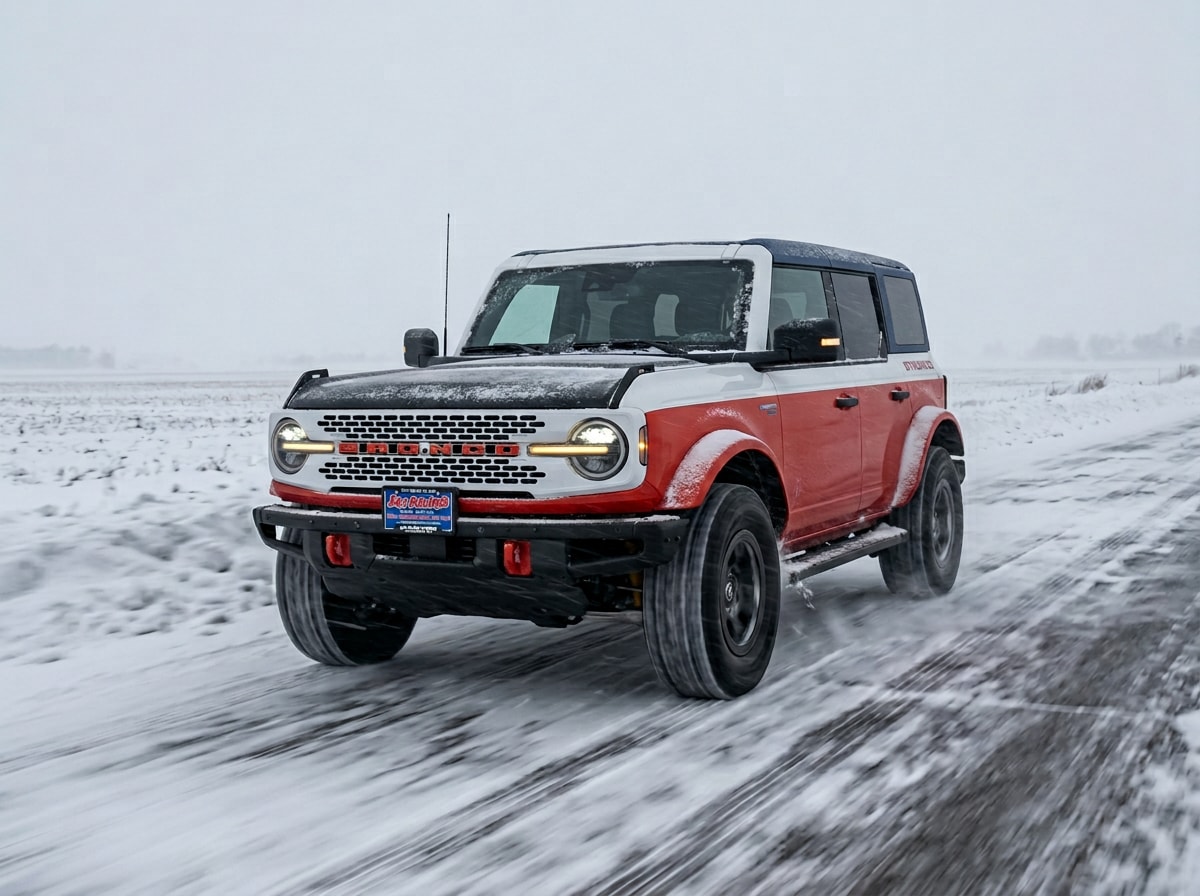
Off-road capability is what the 2026 Ford Bronco® was built around — and what separates it from the Bronco Sport, the Explorer, and pretty much every other SUV at Jay Malone Ford. But “off-road capable” means different things on different trims, and the gap between a stock Big Bend and a Raptor with HOSS 4.0 is enormous. This guide walks through every off-road system on the 2026 Bronco — G.O.A.T. Modes, the HOSS suspension ladder, the Sasquatch™ Package, lockers, low range, Trail Control, geometry — and explains which features matter for which kind of off-road use.
On This Page
Every 2026 Bronco comes with a real 4x4 transfer case — not all-wheel drive. That distinction matters. AWD systems on most crossovers (including the Bronco Sport) automatically shuffle power between the front and rear wheels based on slip, but they don’t have low-range gearing, they don’t lock the driveshafts together mechanically, and they typically lose effectiveness in low-traction situations like deep snow, mud, or rocks where wheel speed and torque multiplication matter more than rapid slip detection.
The Bronco offers two 4x4 systems depending on trim:
4x4 with part-time selectable engagement (standard on Base, Big Bend, Outer Banks, Heritage Edition). You choose between 2H (two-wheel drive, rear), 4H (four-wheel drive high range), 4L (four-wheel drive low range), and on most setups a 4A (auto) mode. Part-time means the system isn’t designed to be left in 4x4 on dry pavement — you engage it when you need it.
Advanced 4x4 with Automatic On Demand Engagement (standard on Badlands and Raptor; included in the Sasquatch Package, Black Diamond Package, and Wildtrak Package). This system can be left in 4A mode full-time, automatically distributing power between front and rear axles based on conditions, and still gives you 2H, 4H, and 4L when you want manual control. It’s a more sophisticated transfer case and a meaningful upgrade for buyers who deal with mixed conditions — gravel one minute, asphalt the next, snow the minute after that.
Both systems include low-range gearing, which is the feature that really separates a real 4x4 from AWD. Low range multiplies torque dramatically — the Bronco can crawl up steep grades, through deep mud, or over rocks at slow speeds without slipping the clutch (manual) or overheating the transmission (automatic). It’s the single most important off-road capability on any 4x4, and every Bronco has it.
G.O.A.T. stands for “Goes Over Any Type of Terrain” — a callback to a description Ford’s Donald Frey reportedly used when explaining what the original 1966 Bronco was supposed to be. In 2026, G.O.A.T. Modes is Bronco’s drive-mode system. It reconfigures throttle response, transmission shift behavior, traction control aggressiveness, and (on capable trims) the differential locking based on what kind of terrain you’re driving on.
Five G.O.A.T. Modes are standard on Base, Big Bend, Outer Banks, and Heritage Edition:
Seven G.O.A.T. Modes are standard on Badlands and Raptor — everything above plus three off-road-specific modes:
For most Minnesota Bronco buyers, the five-mode system covers everything you’ll actually use — Slippery for winter, Normal for everyday, occasional Sport on the highway. The seven-mode system on Badlands and Raptor matters if you trail-run regularly or do real off-road driving on deer leases, ATV trails, or dedicated off-road parks.
HOSS stands for High-Performance Off-Road Stability Suspension — Ford’s naming convention for Bronco’s off-road-tuned suspension systems. There are four HOSS tiers in the 2026 lineup, and they represent meaningfully different suspension hardware, not just tuning differences.
| HOSS Tier | Hardware | Standard On / Available On |
|---|---|---|
| HOSS 1.0 | HOSS-tuned heavy-duty dampers, passive damping | Standard on Base, Big Bend, Outer Banks |
| HOSS 2.0 | Long-travel HOSS-tuned Bilstein® position-sensitive dampers (rear), passive damping | Standard on Badlands and Heritage Edition; included with any trim that adds Sasquatch Package |
| HOSS 3.0 | FOX™ Internal Bypass Dampers, severe-duty steering rack, front steel bash plates | Available on Badlands (requires Sasquatch); included in the Wildtrak™ Package |
| HOSS 4.0 | FOX Live Valve 3.1 Internal Bypass Semi-Active Dampers, terrain monitoring sensors, Ford Performance control arms (13" front / 14" rear wheel travel) | Standard on Raptor only |
A few things worth understanding about each tier:
HOSS 1.0 is genuinely capable for moderate off-road use. The dampers are tuned for the Bronco’s weight and geometry, and the suspension articulates well. If you’re driving gravel roads, light trails, and snow, you don’t need to upgrade.
HOSS 2.0 adds Bilstein position-sensitive dampers in the rear, which provide more controlled motion at high speeds and over rough terrain. The position-sensitive part is meaningful: the damping rate changes based on where in the travel range the shock is, so you get more compliance on small bumps and more control on big hits.
HOSS 3.0 is a substantial upgrade over 2.0. FOX Internal Bypass dampers use multiple internal bypass valves that progressively change the damping rate as the shock compresses or extends. The result is a suspension that’s plush over small bumps, controlled at high speeds, and resistant to bottoming out on big hits. New for 2026, this tier is available on Badlands as a standalone option (52Z) when you also have Sasquatch, or as part of the Wildtrak Package.
HOSS 4.0 on the Raptor is in a different category. The FOX Live Valve dampers are semi-active — the damping rate changes electronically based on inputs from terrain monitoring sensors, the throttle, the brakes, the steering angle, and the wheel position sensors. The system can stiffen or soften the suspension on the fly, multiple times per second. Combined with Ford Performance control arms that allow 13" front / 14" rear wheel travel, this is what makes the Raptor a high-speed desert vehicle and not just a trail truck.
The Sasquatch Package is the single biggest off-road upgrade you can make to a non-Raptor Bronco, and it’s available on Base, Big Bend, Outer Banks, and Badlands (and standard on Heritage Edition). It’s the cheapest way to get electronic-locking front and rear differentials in the lineup.
The Sasquatch Package adds:
The 35" rugged-terrain tires are the most visible upgrade, but the lockers are the meaningful one. An open differential sends torque to the wheel with the least traction — in a stuck situation, that means power goes to the wheel that’s spinning freely while the other wheel sits still. A locked differential mechanically connects both wheels on an axle so they spin at the same speed regardless of traction. Front and rear lockers means all four wheels can put down power simultaneously, which is what gets you out of situations where two wheels are off the ground.
The 4.7 final drive ratio is also worth understanding. Lower (numerically higher) ratios trade highway efficiency for low-end torque multiplication. Combined with the 7-speed manual’s Granny Gear or the 10-speed automatic’s 4L low range, the 4.7 ratio gives Sasquatch-equipped Broncos enormous mechanical advantage at slow speeds — the kind that lets you crawl over rocks or up steep grades with the throttle barely cracked open.
A note on Sasquatch and packages: on Big Bend, Sasquatch requires the Black Diamond Package as well. On Outer Banks and Badlands, it stands alone. The 60th Anniversary Package on Outer Banks requires Sasquatch. The Wildtrak Package on Badlands includes Sasquatch.
The 10-speed automatic transmission unlocks three trail-specific driver assistance features that aren’t available with the manual. These are genuinely useful in real off-road situations — not gimmicks.
Trail Control. Cruise control for off-road. Set a speed between roughly 1 and 20 mph and Trail Control will manage throttle and braking to maintain that speed regardless of grade or obstacle. It frees you to focus entirely on steering and line selection while the truck handles speed management. Standard on every 10-speed automatic Bronco, so it’s available across the lineup.
Trail Turn Assist. When activated, Trail Turn Assist briefly applies the inside rear brake during low-speed turns. The result is a much tighter turning radius — useful on narrow trails, switchbacks, and tight off-road situations where the Bronco’s 100"-plus wheelbase would otherwise be a limitation. Available with the 10-speed automatic on every Bronco trim.
Trail One-Pedal Driving. A more recent addition. When activated in low-range, lifting off the accelerator brings the vehicle to a controlled stop using engine braking and the brake system together — you don’t need to actively apply the brake pedal. It’s designed for technical situations where managing throttle and brake simultaneously with one foot would be hard. Available on Outer Banks, Badlands, Stroppe, and Raptor with the 10-speed automatic.
All three features rely on the automatic transmission’s ability to precisely modulate torque output, which the 7-speed manual can’t do without driver input. If you’re leaning toward the manual for off-road purity, you should know that you’re trading these specific assists for the manual’s Granny Gear and Crank in Gear function.
Geometry numbers tell you what kind of obstacles a vehicle can physically clear. Three numbers matter for off-road: approach angle (how steep an obstacle you can drive up to without the front bumper hitting), breakover angle (how steep a peak you can drive over without the chassis high-centering), and departure angle (how steep an obstacle you can drive away from without the rear bumper dragging). Ground clearance is the height of the lowest point of the chassis above the ground, and water fording is the maximum water depth you can drive through without getting water into the engine or electrical systems.
2026 Bronco geometry by configuration (approximate, varies with tire and package):
Approach, breakover, and departure angles on top configurations reach approximately 43.2 degrees, 29 degrees, and 37.2 degrees respectively. Stock configurations are slightly less aggressive but still better than virtually any unibody crossover.
For context: most production crossovers (including the Bronco Sport in non-Badlands trims) have approach angles in the 20-degree range and ground clearance under 8". The full-size Bronco is a different category, and that geometry is why it can drive places the Bronco Sport physically can’t.
The 2026 Bronco is one of the few new vehicles you can buy with a true off-road-focused manual transmission. The 7-speed manual (available with the 2.3L EcoBoost on Base, Big Bend, Badlands, and Heritage Edition) includes two features that genuinely matter on technical terrain.
Granny Gear (first gear). First gear in the 7-speed manual is intentionally very low — lower than any normal driving situation requires. You don’t use it to start from a stop on pavement (you start in second). You use it for crawling over obstacles in low range, where the combination of the Granny Gear ratio and the low-range transfer case creates an extreme torque multiplication that lets the truck idle up technical terrain at walking speed.
Crank in Gear function. Most manual transmissions require you to depress the clutch to start the engine. The Bronco’s 7-speed lets you start the engine with the transmission in gear and the clutch released — useful when you stall in a difficult spot on a steep grade and don’t want to roll backward while you fumble for the clutch.
Hill Descent Control. Standard with the 7-speed manual (and with the 10-speed automatic). Maintains a steady downhill speed using the brakes individually on each wheel, freeing you to focus on steering. Useful both off-road and on icy hills.
The trade-off with the manual is the 10-speed automatic’s trail features — Trail Control, Trail Turn Assist, and (on certain trims) Trail One-Pedal Driving. If you’re leaning manual for the off-road feel and the Granny Gear, you’re trading those assists. Most experienced off-roaders consider the trade worthwhile; most newer off-roaders find the automatic’s assists genuinely helpful.
The Bronco Raptor is a different vehicle than the trims below it — not a Badlands with a bigger engine, but a different category of off-road truck. A few specifics that separate the Raptor:
The Raptor is designed around high-speed off-road driving — desert running, washboard roads, fast trails — in addition to the rock-crawling and technical terrain that Badlands handles well. The Live Valve dampers are what make this possible: a passive shock can be tuned for slow-speed compliance OR high-speed control, but not both. Live Valve handles both because the shock adjusts dozens of times per second based on what the truck is actually doing.
Honest take: most central Minnesota off-road use doesn’t need the Raptor’s capability. We don’t have desert. We don’t have high-speed off-road parks. The Raptor’s strengths come into play when you’re running 60 mph across rough terrain, and that’s a kind of driving most Minnesota Bronco buyers don’t actually do. If you want the most capable off-road Bronco regardless, the Raptor is it. If your off-road use is trails, gravel, snow, and ice, a Badlands with the Wildtrak Package gets you most of the capability for considerably less.
Off-road capability isn’t one thing — it’s a stack of features that matter for different kinds of driving. A few decision frameworks based on what we hear from customers in Hutchinson and central Minnesota:
If you mostly drive on pavement, gravel roads, and snow: stock Big Bend or Outer Banks is plenty. HOSS 1.0, five G.O.A.T. Modes, real 4x4 with low range, and 32" all-terrain tires cover everything Minnesota throws at a daily driver. You don’t need lockers, you don’t need 35" tires, you don’t need HOSS 3.0.
If you run trails on weekends or hunt on rough access roads: Big Bend with Sasquatch, or Badlands stock. Sasquatch gets you lockers and 35" tires; Badlands adds HOSS 2.0, full bash plates, rock rails, and the seven-mode G.O.A.T. system. Either covers most central Minnesota trail use.
If you off-road regularly and want the best of the non-Raptor lineup: Badlands with the Wildtrak Package. Adds the 2.7L V6, HOSS 3.0 with FOX Internal Bypass dampers, and the Black Appearance treatment. Closest thing to a Stroppe Edition you can buy retail.
If you want maximum capability and don’t care about cost: Raptor. 418 hp, HOSS 4.0, 37" tires, 13.1" clearance, 37" water fording. Nothing else in the lineup approaches it.
If you want lockers without committing to Badlands: Sasquatch on Big Bend or Outer Banks. Same lockers, 4.7 ratio, and 35" tires that come on Badlands — just without the steel bumpers, full bash plates, marine vinyl seats, and rubberized flooring.
If you want the front sway bar disconnect specifically: Badlands. New for 2026, the disconnect is available as a standalone option (68M) on Badlands without requiring Sasquatch — previously you had to add Sasquatch to get the disconnect, which forced 35" tires you might not have wanted.
For more on how trims compare overall, see our 2026 Bronco trim levels guide — and for the full year-over-year spec breakdown, head to the 2026 Bronco overview.
Key Takeaways
The Bronco doesn’t offer AWD — every trim comes with real 4x4. The difference is mechanical: AWD systems shuffle power between front and rear wheels based on slip, but they don’t have low-range gearing or locking differentials. The Bronco’s 4x4 system gives you 2H, 4H, and 4L (low range), with optional electronic-locking diffs. For low-traction situations like deep snow, mud, or rocks, 4x4 is meaningfully more capable than AWD.
No. For Minnesota winter driving, a stock Bronco with good winter tires is more than enough. The Slippery G.O.A.T. Mode handles ice. Standard 4x4 handles deep snow. The Sasquatch Package adds capability for off-road snow and serious low-traction situations, but it’s overkill for everyday winter commuting in Hutchinson.
Not as a Ford-installed package. Sasquatch has to be ordered as part of the original build. You can replicate parts of it after the fact (35" tires, aftermarket lockers, larger fender flares), but it’s significantly more expensive and you lose the integration with the rest of the vehicle’s electronics. If you want Sasquatch, order it from the factory.
4-Auto (available on Advanced 4x4 systems) automatically shuffles power between front and rear axles based on conditions — you can leave it engaged on dry pavement. 4-High locks the front and rear driveshafts together at normal gearing — for moderate off-road or low-traction conditions, but not safe on dry pavement (causes driveline binding). 4-Low engages the low-range gear set for serious low-speed off-road work, multiplying torque dramatically.
If you actually run high-speed off-road or technical terrain regularly, yes — the FOX Internal Bypass dampers are a substantial upgrade over Bilstein position-sensitive units. If you mostly drive on pavement and occasionally hit gravel or trails, no — HOSS 2.0 (standard on Badlands) is more than capable. HOSS 3.0 is genuinely better off-road, but the difference matters most at speed and on rough terrain.
The front sway bar (anti-roll bar) keeps the truck from leaning excessively in corners on pavement — but off-road, it limits how much one front wheel can move independently of the other. Disconnecting the sway bar lets the front suspension articulate fully, putting more rubber on the ground over uneven terrain. The Bronco’s electronic disconnect lets you toggle this from inside the truck without crawling underneath. Standard on Raptor, included with Sasquatch on Badlands, and (new for 2026) available as a standalone Badlands option without Sasquatch.
Yes, if you do it correctly — slowly, steadily, with sealed door seals and the air intake high enough to clear the water line. The 33.5" figure (or 37" on Raptor) is the maximum recommended depth, not a casual driving target. We don’t recommend trying it without prior experience or a clear understanding of the bottom you’re crossing. But the rating is real, and the Bronco is one of the few production SUVs you can buy with that kind of fording capability.
Off-road capability is hard to evaluate from a spec sheet. Come down to our Hutchinson showroom on Highway 7 and we’ll walk you through the trims side by side, show you the difference between HOSS 2.0 and 3.0 in person, and set up a test drive on roads that aren’t just a parking lot loop. If we don’t have your exact spec on the lot — whether that’s a Badlands with the Wildtrak Package, a Big Bend with Sasquatch, or a Raptor with the Code Orange package — we’ll find one or order it from the factory at no extra charge.
About the Author
I’m Jordan Malone-Forst, Assistant General Manager at Jay Malone Motors in Hutchinson, MN. I’m proud to be part of the family business my dad Jay started in 2005 — and even prouder to serve the community I grew up in. When I’m not at the dealership, you’ll find me involved with the Hutchinson Ambassadors and Chamber of Commerce. If you have questions about any Ford vehicle or want to talk through your options, reach out — I’d love to help.