💵
Value My Car → We Buy Cars — Even If You Don’t Buy From Us.
Get a real offer on your vehicle in minutes. No obligation, no pressure.

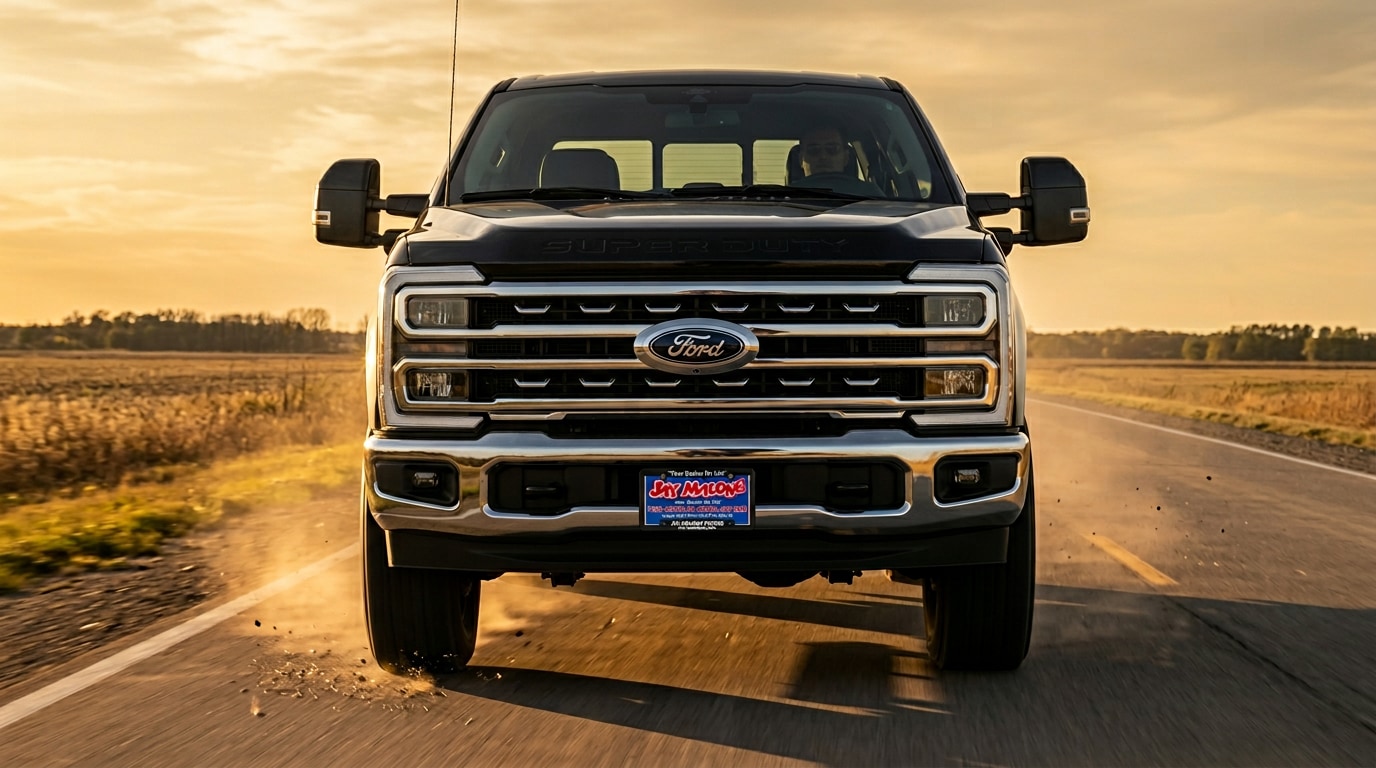
The single biggest decision when ordering a 2026 Ford Super Duty® isn’t XL versus Lariat or Crew Cab versus SuperCab — it’s gas versus diesel, and which of the four available engines fits your actual use. Ford offers the 6.8L 2V V8 Gas (405 hp / 445 lb-ft), the 7.3L 2V V8 Gas “Godzilla” (430 hp / 485 lb-ft, best-in-class gas power), the 6.7L Power Stroke® V8 Turbo Diesel B20 (475 hp / 1,050 lb-ft), and the 6.7L High-Output Power Stroke V8 Turbo Diesel (500 hp / 1,200 lb-ft, best-in-class diesel power). All four pair with a 10-speed automatic. The diesel adds roughly $10,000 to the purchase price — a meaningful number that has to pay back through use. This guide walks through each engine in detail, when each one makes sense, and a real decision framework based on how you actually use the truck.
On This Page
Quick-reference summary before the deep dives:
The big-picture takeaway: the gas engines cost less and work great for moderate towing and family use. The diesels cost more (about $10,000 to add) but deliver the extra towing capacity, the long-haul fuel economy, and the long-term durability under hard use. Choosing right means matching the engine to how you actually use the truck.
The 6.8L 2V DEVCT NA PFI V8 is the standard engine on XL, XLT, and Lariat F-250/F-350. “NA” means naturally aspirated, “PFI” means port fuel injection, “DEVCT” refers to the variable cam timing technology. It’s a heavy-duty work-truck V8 designed for reliability and lower acquisition cost.
Specs:
Where it shines:
Where it’s less ideal:
Best fit: XL fleet trucks, contractors who tow under 12,000 lbs, recreational buyers who tow occasionally, work trucks that don’t need diesel torque, snowplow operations where gas reliability in cold weather is preferred, lower-mileage personal use.
The 7.3L 2V DEVCT NA PFI V8, nicknamed “Godzilla” in the truck community, is the largest displacement gas engine in the heavy-duty pickup segment and produces the highest gas horsepower output. It’s standard on King Ranch and Platinum trims; optional on XL, XLT, and Lariat.
Specs:
Where it shines:
Where it’s less ideal:
Best fit: XLT and Lariat buyers towing 12,000-18,000 lbs, King Ranch and Platinum buyers who don’t need diesel, recreational towers with mid-size fifth-wheel campers (under 18,000 lbs loaded) who don’t want diesel maintenance, anyone wanting Tremor Off-Road Package without going diesel, buyers concerned about long-term diesel maintenance costs.
The 6.7L 4-Valve OHV Power Stroke V8 Turbo Diesel is the volume diesel option in the Super Duty lineup. The B20 designation means the engine is approved to run on biodiesel blends up to 20%. Optional on all retail F-250/F-350 trims. Standard on F-450 retail.
Specs:
Where it shines:
Where it’s less ideal:
Best fit: serious recreational towers (15,000+ lb fifth-wheels, larger horse trailers), commercial operators putting on heavy mileage, F-450 buyers (where it’s standard), anyone towing in mountains or at altitude regularly, buyers who plan to keep the truck 7+ years and want diesel longevity, ranchers and ag operators who run the truck hard.
The High-Output (HO) Power Stroke is the maximum-capability engine in the lineup. Same fundamental architecture as the 6.7L Power Stroke but tuned for substantially more power and torque. It’s required for the Platinum Plus Package. Optional on most retail F-250/F-350 configurations.
Specs:
Where it shines:
Where it’s less ideal:
Best fit: commercial operators, professional gooseneck haulers, buyers regularly towing 22,000+ lbs, anyone configuring a Platinum Plus Package (it’s required), buyers who want maximum capability and don’t want to compromise.
Gas or Power Stroke diesel? See which Super Duty trucks are on our lot.
Both 10-speed automatics are designed specifically for the Super Duty, but they’re not the same transmission — the difference matters for buyers paying attention to specifications.
TorqShift-G ten-speed automatic. Paired with the 6.8L gas and 7.3L gas engines. The “G” designation refers to its tuning for gas torque output. First gear ratio of 4.691:1, designed to optimize off-the-line acceleration with naturally aspirated gas torque curves.
TorqShift ten-speed automatic (no “G”). Paired with the 6.7L Power Stroke and 6.7L HO Power Stroke diesel engines. Reinforced internals to handle the diesel’s significantly higher torque output (1,050-1,200 lb-ft vs. 445-485 lb-ft on gas). First gear ratio of 4.615:1, designed for diesel torque characteristics.
Both transmissions offer the same Selectable Drive Modes:
On 4x2 diesel and 4x4 diesel: additional Trail (4x2) or Off-Road (4x4) drive modes available.
On Tremor Off-Road Package: two additional modes — Rock Crawl and Trail Control. These are unique to Tremor and add capability beyond the standard drive mode set.
The diesel engine adds roughly $10,000 to the purchase price. To pay back, the diesel needs to deliver enough fuel savings, capability premium, or longevity benefit to justify that upfront cost. Here’s the practical framework we walk through with buyers:
How many miles per year do you drive?
What’s your typical towing weight?
What’s your typical towing terrain?
How long will you keep the truck?
How much do you value diesel torque feel? The driving experience of a diesel-towing truck is genuinely different from a gas-towing truck. The low-RPM torque, the engine-exhaust braking, the fuel range when towing — these aren’t spec sheet items, they’re experiential. Some buyers want the diesel experience and pay the premium specifically for that. That’s a legitimate reason to choose diesel even if the spreadsheet doesn’t make it pencil out.
Quick rule of thumb: if you tow over 12,000 lbs regularly OR put on more than 25,000 miles per year OR plan to keep the truck 10+ years, the diesel typically pays back. If you tow occasionally and run lower mileage, the 7.3L Godzilla gas is often the smarter economic choice with comparable everyday capability.
Some specific buyer profiles based on conversations on the Hutchinson sales floor:
The fleet operator or commercial XL buyer. 6.8L gas. Lowest acquisition cost, simplest maintenance, no DEF management. The right answer for fleets where vehicles are spec’d for cost and reliability.
The contractor running tools and a 6,000-10,000 lb trailer. 6.8L gas in XLT or Lariat. The 6.8L handles this towing range without strain. Pro Power Onboard 400W (XLT and higher) is more relevant than diesel torque for jobsite work.
The recreational tower with a 12,000-15,000 lb fifth-wheel camper. 7.3L Godzilla gas (XLT or Lariat) OR 6.7L Power Stroke diesel (Lariat or higher). Honest tradeoff: the Godzilla saves $10,000 upfront but you’ll work it harder on grades and fuel economy will suffer when towing. Diesel is the better long-term answer if you tow regularly.
The horse trailer hauler running 8,000-15,000 lb loads. 6.7L Power Stroke diesel (Lariat or King Ranch). The diesel torque, fuel economy under load, and engine-exhaust braking all matter for this use case. Resale value benefit also applies.
The serious commercial gooseneck operator. 6.7L HO Power Stroke. Approaching the upper end of Super Duty capability requires the HO engine. F-350 DRW or F-450 depending on weight.
The Tremor Off-Road Package buyer. Choice between 7.3L Godzilla, 6.7L Power Stroke, or 6.7L HO Power Stroke. The 6.8L is NOT available with Tremor. For most Tremor buyers, the 7.3L Godzilla is the right balance of capability and cost. For serious off-road towing or maximum capability, go diesel.
The snowplow operator. 6.8L or 7.3L gas. Gas engines start more reliably in extreme cold, and the Snowplow Prep Package is fully compatible with both. The diesel option works fine for plowing if the truck has other diesel justification, but gas is the simpler answer for plow-focused buyers.
The Platinum Plus Package buyer. 6.7L HO Power Stroke. Required for the package — no choice. The 500-hp HO Power Stroke pairs with the maximum-equipment Platinum Plus configuration as the flagship Super Duty.
The buyer who can’t decide between gas and diesel. Drive both back-to-back with a real trailer if possible. The gas vs. diesel feel is genuinely different, and most buyers know which one is right for them after that direct comparison.
A few central-Minnesota-specific points worth thinking through:
Cold-weather starting. Diesel engines need extended cranking in extreme cold (below 0°F) without block heater use. The Super Duty diesel comes with factory cold-start provisions including a glow plug system, but for buyers who park outside in winter we strongly recommend using the engine block heater (standard on diesel; uses a 110V outlet, plug in for 2-3 hours before starting). Gas engines start more easily in cold weather without preconditioning.
Snowplow Prep Package on diesel. Includes the Rapid-Heat Supplemental Cab Heater (option 41A) on diesel models — matters for plow operators who need cab heat available immediately on cold mornings. The diesel also gets the 410 Amp Dual Alternator (vs 190 Amp single alternator with gas engine Snowplow Prep). For commercial plowing operations running multiple electrical accessories (lightbars, plow controllers, two-way radios), the dual alternator headroom matters.
Diesel fuel availability in central MN. Diesel is widely available at major fuel stations along Highway 7, US-12, and MN-15. Less common at smaller rural stations — if you’re running through Renville County or Meeker County back roads, plan fuel stops at known diesel stations. DEF (Diesel Exhaust Fluid) is also widely available at major fuel stations and most farm supply stores.
Long highway runs. The Hutchinson-to-Twin Cities commute (about 60 miles each way), Hutchinson-to-Sauk Centre, Hutchinson-to-Black Hills (about 8 hours one way), or any extended highway run is where diesel fuel economy advantages compound. Buyers running these routes regularly benefit more from diesel than buyers staying within McLeod County most of the time.
Towing in Minnesota terrain. Most of MN is flat to gently rolling. The capability difference between 7.3L gas and 6.7L diesel is smaller here than it would be in mountain country. For Minnesota-only towing with no mountain trips, the 7.3L Godzilla closes much of the gap to diesel without the diesel premium.
Ag use considerations. Farm operations that run trucks hard year-round — livestock hauling, equipment moving, gooseneck towing — tend to put on enough miles and tow heavy enough to justify diesel. Ag use is one of the strongest cases for diesel in central Minnesota.
Quick reference for which engines are available on which trims:
XL:
XLT:
Lariat:
King Ranch:
Platinum:
Tremor Off-Road Package availability: requires 7.3L gas, 6.7L Power Stroke, OR 6.7L HO Power Stroke. The 6.8L gas is NOT available with Tremor.
For more on the Super Duty trim lineup specifically — including standard equipment, package availability, and which trim fits which buyer — see our 2026 Ford Super Duty trim levels guide.
Key Takeaways
Narrowed down your Super Duty? Get your numbers first.
Checking won’t affect your credit score. Pre-qualification is not a loan approval.
It’s a Ford engineering nickname that stuck in the truck community. The 7.3L is the largest displacement gas engine in the heavy-duty pickup segment and produces best-in-class gas power output (430 hp / 485 lb-ft). The nickname references the engine’s exceptional performance as a naturally aspirated V8 in an era when most heavy-duty competitors are running smaller-displacement turbocharged engines or focusing on diesel exclusively. It’s a real engine spec, not a marketing name — the “7.3L 2V DEVCT NA PFI V8 Gas” is what shows up on the order guide.
Depends on use. The diesel adds roughly $10,000 to the purchase price. Under heavy towing loads, diesel fuel economy is typically 30-50% better than gas — meaningful savings over 100,000+ miles. For high-mileage operations (over 25,000 miles per year) or regular heavy towing (over 12,000 lbs), the diesel typically pays back through fuel savings alone. Add resale value advantages and longer service life under hard use, and the total cost of ownership tilts toward diesel for buyers in those use cases. For occasional towing and lower-mileage personal use, the diesel premium is harder to recover, and the 7.3L Godzilla gas is often the smarter economic choice.
B20 designation means the engine is approved by Ford to run on biodiesel blends up to 20% (B20 fuel). It will run on regular #2 diesel just fine — the B20 designation just means biodiesel-compatible fuel is also approved. Most fuel stations sell standard #2 diesel; biodiesel blends are more common at agricultural fuel cooperatives. The B20 capability is meaningful primarily for ag operators who source fuel from cooperatives that blend with biodiesel.
Yes for retail F-250/F-350 trims (XL, XLT, Lariat, King Ranch, Platinum), but with configuration restrictions. The HO is NOT available with W3A 160" wheelbase or X3A 148" wheelbase combinations — consult the order guide or call us for specific configuration availability. The HO is required for the Platinum Plus Package. F-450 retail offers the 6.7L Power Stroke standard with the HO Power Stroke optional.
The Tremor Off-Road Package is engineered around the higher torque output of the 7.3L gas (485 lb-ft) or the diesels (1,050-1,200 lb-ft). The Tremor adds 35-inch off-road tires, modified suspension, and ride-height increase — the 6.8L’s 445 lb-ft of torque doesn’t pair as effectively with the heavier wheels and rolling resistance. For Tremor buyers wanting gas operation, the 7.3L Godzilla is the right engine. For maximum off-road tow capability, the diesels are the answer.
DEF runs about $10-15 for a 2.5-gallon container at fuel stations, less if you buy in bulk at farm supply stores or industrial suppliers. The Super Duty’s DEF tank holds enough for thousands of miles between refills depending on use intensity. Heavy towing burns DEF faster than light driving. Most buyers find DEF refills are needed every 3,000-7,000 miles depending on duty cycle. It’s a real consumable cost but small in the context of total operating expense.
Same fundamental engine architecture — same 6.7L displacement, same OHV V8 configuration, same Power Stroke heritage. The HO version is tuned for higher peak power output (500 hp vs 475 hp) and substantially more peak torque (1,200 lb-ft vs 1,050 lb-ft). The HO has reinforced internals to handle the increased loads, an upgraded turbocharger, and tuning calibration optimized for maximum capability. Practical difference: the HO handles loads at the upper end of Super Duty tow ratings (over 22,000 lbs) more comfortably. For most diesel buyers towing under 22,000 lbs, the standard Power Stroke is plenty.
If you’ve narrowed down which engine fits your work, the next step is figuring out the right trim, drivetrain, and packages to pair with it. Come down to our Hutchinson showroom on Highway 7, and we’ll set you up with a real test drive that includes the kind of roads you actually drive on. If you can’t decide between gas and diesel, we’ll arrange back-to-back test drives so you can feel the difference yourself.
If we don’t have your exact configuration in stock, we’ll either pull one from another dealer at no extra charge or place a factory order through Ford. Same price either way — that’s how we’ve operated since 2005.
About the Author
I’m Jordan Malone-Forst, Assistant General Manager at Jay Malone Motors in Hutchinson, MN. I’m proud to be part of the family business my dad Jay has owned and operated since 2005 — and even prouder to serve the community I grew up in. When I’m not at the dealership, you’ll find me involved with the Hutchinson Ambassadors and Chamber of Commerce. If you have questions about any Ford vehicle or want to talk through your options, reach out — I’d love to help.