
If you’re shopping for a used full-size SUV in central Minnesota, three vehicles tend to come up in the cross-shop conversation: the Ford Expedition, the Chevy Tahoe, and the Toyota Sequoia. They’re the three most-asked-about full-size SUVs in our showroom for buyers stepping up from a midsize, and the three vehicles most central MN families weigh against each other.
Here’s the honest version of this comparison from a dealership that sells all three on the used lot — the Expedition is what we order, and Tahoes and Sequoias come in on trades, pass our service department inspection, and go on the lot. We’ve driven all three through MN winters, looked at all three on the lift in our service department, and watched what holds up over 100,000+ miles of central Minnesota use.
This is the honest breakdown — what the Expedition does that the others don’t, what trade-offs you should understand on the alternatives, and how to decide which used full-size SUV fits your specific situation in central Minnesota.
Quick Verdict: The Expedition Is the Smart Pick for Most MN Buyers
For most central Minnesota families cross-shopping a used full-size SUV, the Ford Expedition delivers the best combination of capability, cargo, technology, durability, and value — especially the 4th-gen trucks (2018+) with the aluminum body and updated technology. Here’s the short version of why:
Why the Expedition wins:
- Best cargo capacity in the segment (Expedition MAX delivers ~36 cu ft behind the 3rd row)
- Best torque in the standard powertrain comparison (470-510 lb-ft from the twin-turbo EcoBoost vs Tahoe 5.3L V8’s 383 lb-ft)
- Aluminum body that resists MN road-salt rust over the long term (Tahoe and Sequoia are steel)
- Best interior tech, including the segment’s largest touchscreen (15.5" on 2022+ trims) and BlueCruise hands-free driving
- Best max towing (9,300 lbs properly equipped, ahead of both alternatives)
- Best entry pricing — consistently $4,000-$10,000 below comparable Tahoes and Sequoias
Trade-offs to understand on the alternatives:
- Chevy Tahoe: Has the V8 option some buyers want, but comes with documented AFM lifter failure risk on 2014-2019 5.3L V8 trucks, more expensive operating costs, steel body that’s harder on MN salt, and meaningfully higher purchase prices for comparable trims.
- Toyota Sequoia: Holds value well at resale, but you pay for that resale upfront — typically $6,000-$14,000 more than a comparable Expedition. For long-term ownership (8+ years), the Expedition’s lower entry price usually wins on total cost.
Side-by-Side: The 30,000-Foot View
| Category | Ford Expedition | Chevy Tahoe | Toyota Sequoia |
|---|---|---|---|
| Base engine | 3.5L EcoBoost V6 (375-380 hp / 470 lb-ft) | 5.3L V8 (355 hp / 383 lb-ft) | 5.7L V8 (2015-2022) / 3.5L hybrid (2023+) |
| Top engine | 3.5L EcoBoost HO (440 hp / 510 lb-ft on 2022+ Platinum/Stormtrak) | 6.2L V8 (420 hp / 460 lb-ft) | 3.5L hybrid (437 hp on 2023+ only) |
| Max tow capacity | 9,300 lbs | 8,400 lbs | 9,000 lbs (2023+) / 7,400 lbs (pre-2023) |
| Cargo behind 3rd row | ~20 cu ft / ~36 cu ft (MAX) | ~25 cu ft | ~22 cu ft |
| Body construction | Aluminum (4th gen, 2018+) | Steel | Steel |
| Top screen size | 15.5" (2022+) | 10.2" | 14" (2023+) |
| Known service issues | 3.5L EcoBoost intercooler (early), 10-speed shudder (2018 launch — resolved) | AFM lifter failure on 5.3L V8 (2014-2019), 10-speed transmission shudder (2021+) | Fewer documented campaigns; conservative engineering |
| Typical used price | Best value | $4K-$10K higher than Expedition | $6K-$14K higher than Expedition |
Where the Ford Expedition Pulls Ahead
Cargo capacity, especially in MAX configuration. The Expedition MAX delivers ~36 cu ft behind the 3rd row — substantially more than the Sequoia (~22 cu ft) and meaningfully more than the standard Tahoe (~25 cu ft). For Minnesota families who travel with a full passenger load AND luggage — hockey families, camping families, road trippers — the MAX is the clear cargo winner in the segment.
Twin-turbo torque. The 3.5L EcoBoost V6 produces more torque (470-510 lb-ft depending on tune) than the Tahoe’s 5.3L V8 (383 lb-ft) and matches the Tahoe 6.2L V8 (460 lb-ft) while making 20 more horsepower in High Output form. Peak torque arrives at lower RPM than the V8s, which actually helps in tow situations and around-town acceleration. The High Output version on 2022+ Platinum and Stormtrak trims (440 hp / 510 lb-ft) is the most powerful engine in this entire comparison.
Aluminum body for MN salt. The 4th-gen Expedition (2018+) uses an aluminum body, the same approach Ford has taken on the F-150 since 2015. Aluminum doesn’t rust the way steel does in road-salt conditions. Both the Tahoe and Sequoia use steel bodies. Over 8-10 years of central Minnesota winter exposure, that difference shows up in the form of underbody rust, rocker panel corrosion, and tailgate deterioration. The Expedition’s aluminum construction is a genuine long-term ownership advantage you don’t see in the spec sheet.
Maximum towing. Properly equipped 4th-gen Expeditions tow up to 9,300 lbs — ahead of the Tahoe (8,400 lbs even with the 6.2L V8) and the 2023+ Sequoia (9,000 lbs). Pre-2023 Sequoias top out at 7,400 lbs. If towing capacity matters to you, the Expedition leads the segment.
Interior technology. The 2022+ Expedition with SYNC 4A and the 15.5" touchscreen has the largest, most modern infotainment display in this comparison. BlueCruise (Ford’s hands-free highway driving system) is available on equipped 2022+ trims. The Tahoe and Sequoia have hands-free or large-screen options on certain configurations, but the Expedition’s standard tech package across most trims is meaningfully ahead.
Best entry-level pricing. Used Expeditions consistently price below comparable Tahoes and Sequoias on the central MN market. A 2020 Expedition Limited typically runs $4,000-$8,000 less than a comparable 2020 Tahoe LT, and $6,000-$12,000 less than a comparable 2020 Sequoia Limited. For value-focused buyers, the Expedition delivers more vehicle for the dollar at the moment of purchase.
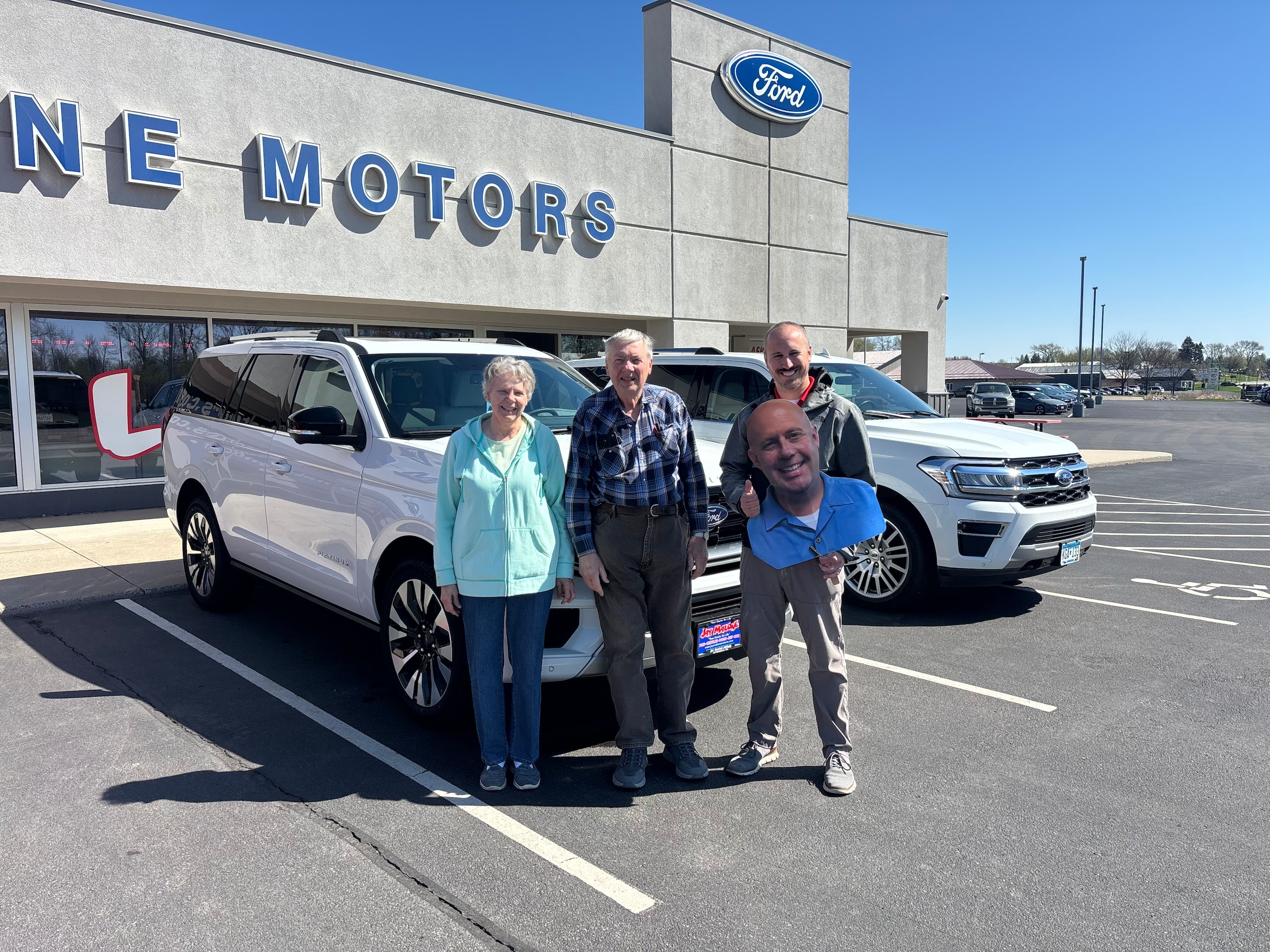
A Jay Malone Ford customer with their used Expedition. One of our most popular used Ford SUVs.
Trade-Offs to Understand on the Chevy Tahoe
The Tahoe is a known quantity on the central MN market — lots of them on the road, broad parts availability, and the V8 option some buyers specifically want. Here’s the honest version of what you should understand before buying a used one.
AFM lifter failure is a real concern on 2014-2019 5.3L V8 trucks. Active Fuel Management (AFM) is GM’s cylinder deactivation system that shuts off four cylinders under light loads for fuel economy. On 5.3L V8 trucks of this generation, the AFM lifters have a well-documented failure pattern — lifter collapse leads to camshaft damage and, in severe cases, engine replacement. GM addressed the issue with service campaigns but it remains a known risk on these model years. Used 5.3L Tahoes from this generation typically sell at a discount specifically because of this concern. If you’re considering a 2014-2019 Tahoe with the 5.3L, you need a service department that knows what to look for — ours does, on every used vehicle we inspect.
2021+ redesigned Tahoe had launch issues that took years to fully resolve. The 10-speed automatic transmission shudder was widespread enough that GM issued multiple software updates. AC condenser cracks on 2021-2022 trucks were documented by GM. Newer trucks have these issues addressed, but the early years of the current generation carried real reliability concerns.
Less cargo capacity. The standard Tahoe gives you ~25 cu ft behind the 3rd row — meaningfully less than the Expedition MAX’s ~36 cu ft. The Suburban exists as Chevy’s long-wheelbase answer, but it’s sold as a separate model at a meaningful price premium and carries the same AFM and platform concerns as the Tahoe.
Steel body is harder on MN salt. Same long-term consideration as the Sequoia — over 8-10 years of central Minnesota winter exposure, steel-bodied vehicles show their age in ways aluminum-bodied vehicles don’t. The Expedition’s aluminum body is a meaningful advantage for long-term MN ownership.
Higher pricing for comparable equipment. Used Tahoes typically run $4,000-$10,000 above comparable Expedition configurations. The Tahoe has a V8 option the Expedition doesn’t — but the Expedition’s EcoBoost produces more torque than the Tahoe 5.3L V8 and matches the Tahoe 6.2L V8 with more horsepower in High Output form. The V8 premium isn’t buying you superior capability; it’s buying you V8 character at a higher price point with the trade-offs noted above.
Trade-Offs to Understand on the Toyota Sequoia
The Sequoia is a different proposition than the Tahoe — Toyota’s engineering is genuinely conservative, the 5.7L V8 in 2015-2022 trucks is one of the most durable engines in the segment, and the brand reputation supports strong resale. Here’s the honest version of the trade-offs.
You pay for the resale upfront. Used Sequoias consistently price $6,000-$14,000 above comparable Expeditions on the central MN market. If you trade every 3-4 years, the stronger Sequoia resale recoups some of that premium. If you’re keeping the SUV 8+ years (which most central MN families do), the math shifts — the lower entry price of the Expedition usually wins on total cost of ownership.
Smallest cargo capacity in the comparison. The Sequoia delivers ~22 cu ft behind the 3rd row — less than the Tahoe and less than half of the Expedition MAX. For families who actually use the third row regularly with luggage or gear, this is a real limitation. The Sequoia doesn’t have a long-wheelbase variant.
Older interior technology through 2022. 2015-2022 Sequoias have the older Toyota Entune system with smaller screens and dated interface design. The 2023+ redesign brought a 14" touchscreen and modern Toyota Audio Multimedia, but with some early launch software bugs. For buyers wanting current-generation interior tech, the 2023+ Sequoia or any 2022+ Expedition delivers it; the 2015-2022 Sequoia doesn’t.
Lower towing capacity on 2015-2022 trucks. Pre-2023 Sequoias tow up to 7,400 lbs — less than the Tahoe and meaningfully less than the Expedition. The 2023+ Sequoia hybrid bumps capacity up to 9,000 lbs, but that’s only on the latest generation.
Steel body, same MN salt consideration as the Tahoe. Long-term ownership in central Minnesota road-salt conditions favors aluminum-bodied vehicles. Toyota uses steel construction; over 8-10 years, the difference shows.
The Categories That Actually Matter for Central MN Buyers
Winter performance
All three with 4WD perform well in MN winters. None are off-road vehicles by default (the Timberline, Z71, and TRD Pro trims excepted), but all three handle MN winter when properly equipped with all-season or winter tires. The Expedition’s aluminum body delivers measurable long-term advantage against road-salt corrosion. Edge to: Expedition on long-term winter durability.
Fuel economy
Expedition 3.5L EcoBoost: ~17-19 mpg combined depending on year. Tahoe 5.3L V8: ~17-18 mpg combined. Tahoe 6.2L V8: ~16-17 mpg combined. Sequoia 5.7L V8 (through 2022): ~15 mpg combined. Sequoia hybrid (2023+): ~22 mpg combined. Edge to: 2023+ Sequoia hybrid for buyers prioritizing efficiency in a hybrid full-size SUV; Expedition for best gas efficiency in the standard powertrain comparison.
Cargo space
Expedition MAX (~36 cu ft behind 3rd row, ~121 cu ft behind 1st row): dominant on cargo for the standard SUV footprint. Standard Tahoe (~25 cu ft / ~123 cu ft): less cargo behind 3rd row than the MAX. Sequoia (~22 cu ft / ~120 cu ft): smallest cargo behind the 3rd row in this comparison. Standard Expedition (~20 cu ft / ~104 cu ft): mid-pack. Edge to: Expedition MAX, clearly.
Interior technology
2022+ Expedition with SYNC 4A and the 15.5" touchscreen: largest and most modern infotainment in this comparison. 2023+ Sequoia: 14" touchscreen, competitive. 2021+ Tahoe with the redesigned interior: 10.2" touchscreen, smaller than both competitors. Pre-2022 versions of all three: smaller screens, older systems. Edge to: Expedition on screen size and BlueCruise availability.
Towing capacity
Expedition (properly equipped 4th gen): 9,300 lbs. Tahoe (with 6.2L V8): 8,400 lbs. Sequoia (2023+): 9,000 lbs. Sequoia (2015-2022 5.7L V8): 7,400 lbs. Edge to: Expedition for max capacity.
Value at purchase
Used Expedition pricing consistently runs below comparable Tahoe configurations and significantly below comparable Sequoia configurations. For the same dollar amount, you generally get more truck (newer year, lower miles, or higher trim) in an Expedition than the alternatives. Edge to: Expedition, clearly.
Common Issues by Model — What Our Service Team Inspects
Every used vehicle has known patterns. Here’s what our factory-trained technicians look at on each:
Expedition: 3.5L EcoBoost intercooler condensation on early 3rd-gen trucks (2015-2016, addressed via PCM updates). Timing chain wear on very high-mileage EcoBoost engines with inconsistent maintenance. 10-speed transmission early launch concerns on 2018 trucks (resolved by 2019 via software). Aluminum body requires specialized collision repair — we have the equipment and certification, not every body shop does.
Tahoe: AFM (Active Fuel Management) lifter failure on 5.3L V8s is the headline concern — particularly on 2014-2019 trucks. GM issued service campaigns but the issue remains a known risk on these model years. The 2021+ redesigned Tahoe had transmission shudder on early 10-speed automatics, mostly resolved via software updates. AC condenser cracks on 2021-2022 trucks documented by GM. Steel body susceptible to road-salt rust over time in MN. Heavy oil consumption reports on certain 5.3L V8 builds.
Sequoia: Generally fewer service campaigns than Expedition or Tahoe — Toyota’s conservative engineering shows. 2015-2022 5.7L V8 trucks are remarkably reliable when maintained on schedule. 2023+ launch had some Toyota Audio Multimedia software bugs, mostly resolved via updates. Frame rust on very early Sequoias (pre-2008) was a major issue but 2015+ trucks have updated frame treatment and are not subject to the same concerns. Steel body still requires care in MN salt conditions.
The bottom line: Every full-size SUV in this comparison has service patterns. None are deal-breakers in isolation. The difference is whether the dealer you’re buying from actually inspects for these specific items — especially the AFM lifter concern on 5.3L Tahoes — before pricing the vehicle. Our service department checks all of these every time, on every used full-size SUV we sell, regardless of make.
Pricing Reality on the Central MN Market
Here’s what comparable trims typically run on the central Minnesota used market in 2026:
| Configuration | Expedition | Tahoe | Sequoia |
|---|---|---|---|
| 2018-2019 mid trim 4x4, ~50K mi | $28K-$38K | $32K-$42K | $36K-$46K |
| 2020-2021 mid trim 4x4, ~40K mi | $36K-$48K | $40K-$52K | $44K-$58K |
| 2022-2023 mid trim 4x4, ~25K mi | $44K-$58K | $48K-$62K | $54K-$72K |
| 2022-2023 top trim 4x4 | $58K-$80K (Platinum/Stormtrak) | $62K-$82K (High Country) | $66K-$88K (Capstone) |
| Long-wheelbase variant | MAX: +$2K-$5K over standard | Suburban: separate model, +$3K-$7K over Tahoe | N/A (no long-wheelbase variant) |
Ranges are general guidance for typical central MN inventory. The takeaway: Expedition consistently prices $4,000-$10,000 below comparable Tahoes and $6,000-$14,000 below comparable Sequoias for similar year, trim, and mileage.
The Cross-Shop Conversations We See Most Often
When buyers walk in cross-shopping these three, here’s what usually comes up:
“I’ve always driven Chevys. Why should I look at the Expedition?” — Brand loyalty is real and we respect it. But the Expedition’s EcoBoost produces more torque than the Tahoe 5.3L V8 and matches the Tahoe 6.2L V8 with more horsepower in High Output form. The aluminum body resists MN salt better than steel. The cargo capacity in MAX form is substantially better. The interior tech is meaningfully newer. And the pricing comes in below comparable Tahoes. If you’re open to a test drive, most Chevy-loyal buyers are surprised by what the Expedition delivers.
“I love how the Sequoia holds value, but it’s $8,000 more than the comparable Expedition and I’m keeping it 8-10 years.” — In that scenario, the resale advantage of the Sequoia diminishes. Keeping it long term means the lower entry price of the Expedition wins on total cost of ownership.
“I want a V8.” — That’s a fair preference, and the Expedition is V6-only from 2015 forward. We’ll explain the EcoBoost torque advantage and the High Output 440 hp option on 2022+ Platinum and Stormtrak trims — but if you specifically want V8 character, sound, and configuration, the Expedition isn’t built for that buyer. Just understand the AFM lifter risk on 2014-2019 5.3L Tahoes, and check service history carefully.
“I haul hockey gear, camping equipment, and 6 people on weekends.” — Expedition MAX, almost always. The ~36 cu ft behind the 3rd row is the segment’s cargo king at this size and price point.
“I want the newest technology at this size.” — That conversation almost always ends at the 2022+ Expedition with SYNC 4A and the 15.5" screen. The Sequoia’s 14" on 2023+ is competitive. The Tahoe’s 10.2" is meaningfully smaller. The Expedition’s screen real estate, paired with BlueCruise availability, puts it ahead on interior tech.
Frequently Asked Questions
Is the Ford Expedition the best used full-size SUV for Minnesota?
For most central Minnesota buyers, yes. The Expedition leads the segment on cargo capacity (especially in MAX form), towing (up to 9,300 lbs), interior technology, and value at purchase. The aluminum body construction on 4th-gen trucks (2018+) is a meaningful long-term advantage against MN road-salt corrosion compared to steel-bodied alternatives like the Tahoe and Sequoia.
Why doesn't the Ford Expedition come with a V8?
Ford replaced the 5.4L V8 with the 3.5L EcoBoost V6 for the 2015 model year because the twin-turbo V6 produces more torque (470-510 lb-ft) than the previous V8 and delivers better fuel economy. The High Output version on 2022+ Platinum and Stormtrak trims (440 hp / 510 lb-ft) is actually more powerful than the Tahoe 6.2L V8 (420 hp / 460 lb-ft). The Expedition's EcoBoost approach was a deliberate engineering decision, not a cost-cutting one.
What is the AFM lifter issue on the Chevy Tahoe?
Active Fuel Management (AFM) is GM's cylinder deactivation system that shuts off four cylinders under light loads for fuel economy. On 2014-2019 5.3L V8 trucks, the AFM lifters have a documented failure pattern — lifter collapse leads to camshaft damage and, in severe cases, engine replacement. GM addressed the issue with service campaigns but it remains a known risk on these model years. Any 2014-2019 Tahoe with the 5.3L V8 should be inspected carefully for AFM-related concerns before purchase.
Which full-size SUV has the most cargo space?
The Expedition MAX leads with ~36 cu ft behind the 3rd row, meaningfully more than the standard Tahoe (~25 cu ft), Sequoia (~22 cu ft), or standard Expedition (~20 cu ft). For families who travel with a full passenger load AND luggage, the Expedition MAX hits the sweet spot of cargo capacity and price.
Is the Toyota Sequoia worth the price premium?
Depends on your ownership horizon. Trading every 3-4 years, the Sequoia's stronger resale recoups some of the premium. Keeping the SUV 8+ years (which most central MN families do), the lower entry price of the Expedition usually wins on total cost of ownership. The Sequoia is a well-built SUV with conservative Toyota engineering; the question is whether you value the brand premium and resale enough to pay $6,000-$14,000 more up front and accept smaller cargo capacity in return.
Can the Ford Expedition tow more than the Tahoe and Sequoia?
Yes. Properly-equipped 4th-gen Expeditions tow up to 9,300 lbs, ahead of the Tahoe (8,400 lbs even with the 6.2L V8) and the 2023+ Sequoia (9,000 lbs). Pre-2023 Sequoias top out at 7,400 lbs. The EcoBoost's low-end torque actually helps in tow situations — peak torque arrives at lower RPM than naturally-aspirated V8s.
Does the aluminum body on the Expedition really matter in Minnesota?
Yes, over time. Minnesota road salt is aggressive on steel-bodied vehicles — you see underbody rust, rocker panel corrosion, and tailgate deterioration on 8-10 year old steel SUVs that simply doesn't happen on aluminum-bodied trucks. The 4th-gen Expedition (2018+) uses aluminum body panels, similar to the F-150 since 2015. The Tahoe and Sequoia use steel bodies. If you're keeping the SUV long term in central MN, the aluminum body is a real long-term advantage.
Should I get the Expedition or the Expedition MAX?
Standard Expedition gives ~20 cu ft behind the 3rd row and easier maneuverability. Expedition MAX gives ~36 cu ft. For families traveling with a full passenger load AND luggage, the MAX is the right call. Our complete Used Expedition Buyer's Guide covers the MAX decision in depth.
Can I trade my used Tahoe or Sequoia on a used Expedition?
Yes. Jay Malone Ford takes any make on trade and provides fair appraisals on Tahoe and Sequoia trades. Use the online trade-in tool for an instant estimate, then bring the vehicle for a hands-on appraisal. We can show you the math on trading toward an Expedition, Expedition MAX, or any other vehicle on our lot.
Ready to see why the Expedition is the smart pick?
We have used Expeditions on the lot, and our service team has inspected every one for the specific patterns that matter on these trucks. The best way to decide is to drive one on your normal commute, with your normal driving style, and see how it stacks up against what you’ve been considering. Stop by 1165 Hwy 7 W in Hutchinson — no pressure, no locator fees.
Related Used Vehicle Resources
Used Ford Expedition Buyer’s Guide
Complete guide to used Expeditions 2015-2024: 3rd vs 4th gen, Expedition vs MAX, EcoBoost variants, trims, towing capability, and MN winters.
Read the Expedition Guide →Used SUV or Used Truck?
Cargo, family use, towing, daily driving, and Minnesota winters — how to decide between a used SUV and a used truck.
Read the guide →Used Cars Hutchinson MN
Our complete hub for used cars, trucks, and SUVs at Jay Malone Ford — family-owned, voted Best in Hutchinson.
View the Used Vehicles Hub →About the Author
I’m Jordan Malone-Forst, Assistant General Manager & Marketing at Jay Malone Motors in Hutchinson, MN. I’m proud to be part of the family business my dad Jay started in 2005 — and even prouder to serve the community I grew up in. I’m President of the Hutchinson Ambassadors, serve on the Board of Directors for the Hutchinson Area Chamber of Commerce & Tourism, and was named 2025 Young Leader of the Year. If you have questions about which used full-size SUV is right for your family, reach out — I’d love to help.
Categories:
Pre-Owned Inventory