💵
Value My Car → We Buy Cars — Even If You Don’t Buy From Us.
Get a real offer on your vehicle in minutes. No obligation, no pressure.


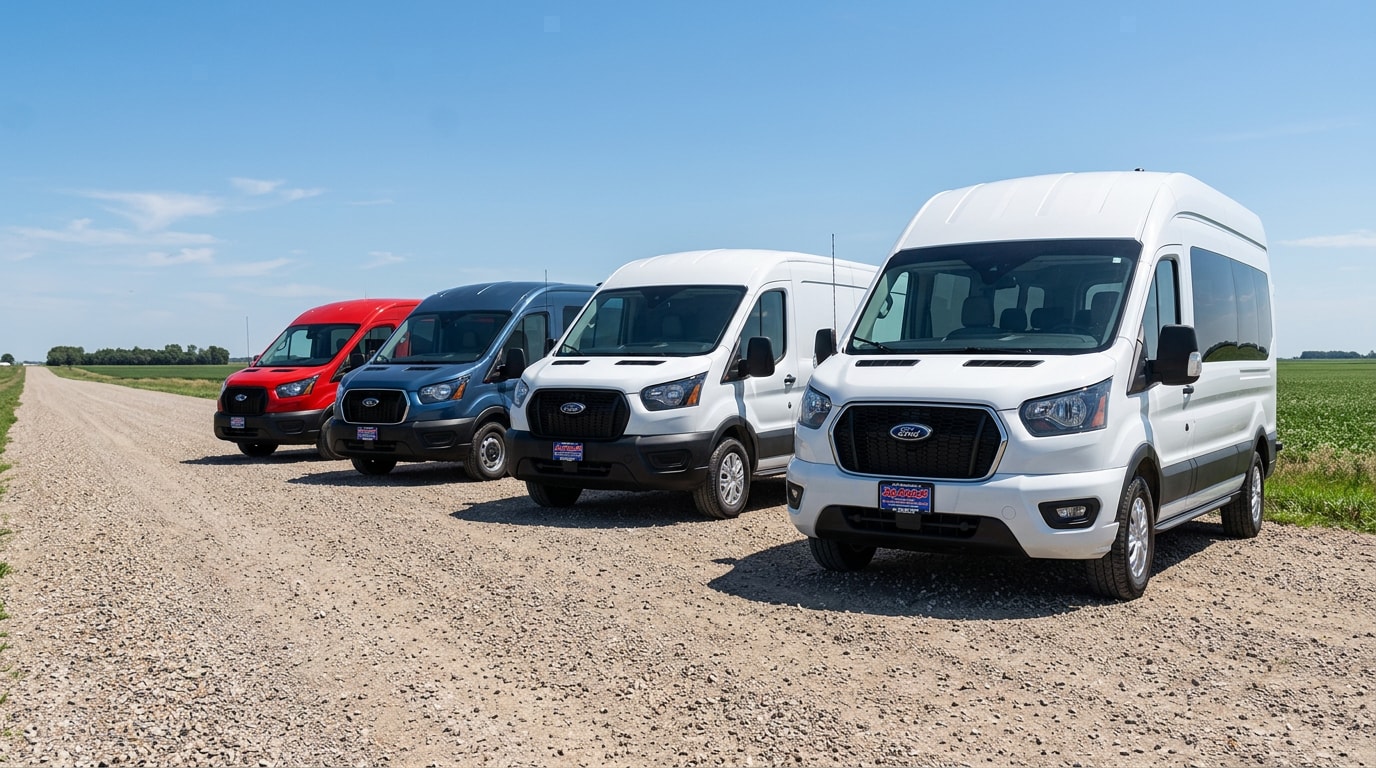
The 2026 Ford Transit® is offered in five distinct body styles — Cargo Van, Passenger Van XL, Passenger Van XLT, Chassis Cab, and Cutaway — each designed for a different commercial use case. Choosing the right body style is the single biggest decision when ordering a Transit because it determines everything else: how the cargo area is configured, what seating arrangements are available, what upfit options apply, and what trade or commercial packages can be added. This guide walks through every Transit body style, what each one is built for, the specific configurations available within each body style, and which one fits which buyer — from electricians and HVAC contractors to school districts, shuttle operators, ambulance services, and commercial body builders across central Minnesota.
On This Page
Quick reference before the deep dives:
The simple decision framework: if you’re hauling cargo and need a standard van shape, it’s Cargo Van. If you’re transporting people, it’s Passenger Van XL or XLT. If you’re installing a custom body, it’s Chassis Cab or Cutaway (the difference between those two depends on the body type).
The Cargo Van is the most common Transit body style and the one that defines most of what people picture when they think “Ford Transit.” Enclosed cargo space behind the driver row with no factory-installed rear seating — the cargo area is open and configurable for whatever the business needs: tools, materials, parts, shelving, refrigeration units, custom upfit equipment.
Cargo Van configurations:
Standard Cargo Van features for 2026: all-new 8-inch cluster display, SYNC 4 with 12-inch center display, Ford Co-Pilot360 standard (Lane-Keeping System, Auto High Beam Headlamps, Pre-Collision Assist, Intersection Assist, Rear View Camera, Forward Sensing System, Reverse Sensing System), keyless push-button Start, 5G modem with over-the-air update capability, and the new rear taillamps with integrated BLIS sensors when equipped.
Available Cargo Van packages and upfit options:
Best fit for Cargo Van: electricians, plumbers, HVAC contractors, general contractors, mobile mechanics, mobile service operations (detailing, vet services, pet grooming, equipment repair), last-mile delivery, courier services, parts delivery, building supply delivery, food and grocery delivery, mobile catering, restaurant supply delivery, locksmiths, security installers, fire suppression service, mobile commercial cleaning.
The Passenger Van XL is the standard passenger trim — factory-installed rear seating for 12 or 15 passengers with work-focused interior trim. Cloth seats, manual climate, no leather or premium upgrades.
Passenger Van XL configurations:
Standard Passenger Van XL features for 2026: all-new 8-inch cluster display, SYNC 4 with 12-inch center display, Ford Co-Pilot360 standard, keyless push-button Start, 5G modem with OTA capability, climate control for passenger compartment, factory seat belt systems for all passenger positions.
Available Passenger Van XL packages:
Best fit for Passenger Van XL: school district activity transport, school district small-route bus service, business crew transport, construction crew transport, church youth and community group transport, nonprofit organization transport (counseling services, senior centers, community programs), 4-H and county fair transport, agricultural worker transport.
The Passenger Van XLT is the comfort-upgraded version of the Passenger Van — same seating capacity as the XL with substantial upgrades to interior trim, technology, and driver-assist features. The right answer for buyers who use the van for premium shuttle operations or want passenger comfort along with capacity.
Passenger Van XLT upgrades vs. XL:
2026 Passenger Van XLT-specific update: 253-Degree Rear Door Hinge Opening now optional on high-roof Passenger Van variants (both LWB and LWB-EL). Provides much wider rear access for loading large items or accommodating wheelchair-accessible upfit applications.
Best fit for Passenger Van XLT: hotel and airport shuttles, premium business shuttle operations, executive transport, corporate fleet (for premium crew transport), tour operations, wedding and event transportation, premium church and nonprofit transport, buyers who want passenger comfort along with capacity, larger families who need 12+ seats but want comfort features.
The Chassis Cab is the Transit’s truck cab and frame only — no rear cargo body, no enclosed cargo area. Designed specifically for commercial body builders who will install a custom rear body. The truck arrives at the body builder ready for upfit.
Common Chassis Cab body upfits:
Chassis Cab configurations for 2026:
For Chassis Cab buyers: talk to your body builder before ordering. Wheelbase choice, drivetrain, model series, and option packages all affect what bodies will fit and how they perform. We can coordinate with body builders to make sure the truck arrives ready for the specific upfit. Jay Malone Ford works with regional body shops regularly, and we’ll connect you with builders we’ve worked with successfully.
The Cutaway is similar in concept to the Chassis Cab but with a small enclosed driver cab area and exposed rear chassis. Designed primarily for applications where the rear body integrates with the cab — box trucks (where the cargo body extends behind the cab) and motorhome conversions (Class C and Class B+ motorhomes).
Common Cutaway upfits:
Cutaway configurations for 2026:
Cutaway vs. Chassis Cab: Chassis Cab has no rear cab structure — the body builder installs everything from the cab back. Cutaway has a small enclosed driver cab with a wall behind the driver, and the rear body extends from that wall back. Chassis Cab is more flexible for service bodies and dump bodies; Cutaway is preferred for box trucks and motorhomes where the body integrates with the cab.
Within each body style, the model series designates the GVWR (Gross Vehicle Weight Rating) class. Same chassis architecture, different weight ratings depending on configuration:
Plan model series based on actual loaded weight. Order the model series that matches your planned use plus reasonable margin. For tradespeople carrying tools, materials, parts, and shelving in a Cargo Van, Transit-250 typically handles the load. For passenger transport at 12-15 passengers, Transit-350 is the standard answer. For heavy commercial body builds (service bodies with full upfit, dump bodies, larger refrigerated bodies), Transit-350 HD SRW or DRW is the right answer.
A few notable 2026 changes affecting body style availability:
Configurations deleted for 2026:
These deletions affect commercial body builders who specifically need T-350 SRW with the longer 156" or 178" wheelbases. For body upfit applications that previously used these configurations, alternatives include T-350 HD SRW or T-350 HD DRW configurations. Talk to us if you’re a body builder or commercial buyer affected by these deletions — we can help spec an alternative configuration.
New for 2026:
Ambulance Prep changes: the Ambulance Prep Package (47F) has been deleted from Chassis Cab for 2026. The Ambulance Prep Package (47B) for Cargo Van remains available. Ambulance body builders working on Chassis Cab configurations should consult Ford’s Body Builder Library or coordinate through us for alternative configuration paths.
Specific buyer profiles for each body style based on conversations on the Hutchinson sales floor:
The electrical contractor with a small crew. Cargo Van, high-roof, 148-inch wheelbase, Electrician Trade Package (66K), 3.5L EcoBoost V6 (more torque for loaded operation), AWD optional for rural MN service work, Pro Power Onboard 2.4 kW for jobsite tools. Transit-250 typically.
The HVAC contractor. Same configuration but HVAC Trade Package (66L) instead. The HVAC package configures shelving and storage specifically for HVAC service tools, copper, ductwork, and parts.
The general contractor. General Contractor Trade Package (66M) configuration. For 2026, available in Extended Long Length — the longest Cargo Van plus factory shelving. The right answer for general contractors who carry larger inventory of tools, materials, and parts.
The mobile mechanic or mobile detailing operation. Cargo Van, medium or high roof depending on whether you work standing inside, 148-inch wheelbase, available Shelving Package (66H) plus custom aftermarket workspace, Pro Power Onboard 2.4 kW for tools, Engine Block Heater for MN winters. Transit-250 typically.
The local-route delivery operation. E-Transit Cargo Van — the right answer for fixed-route delivery operations with overnight depot charging and routes under ~100 miles per day. Vapor Injection Heat Pump standard for 2026 helps cold-weather efficiency in MN winters. Transit-350 typically.
The courier operation. Cargo Van, low or medium roof depending on cargo volume, 130-inch wheelbase for tighter delivery routes and easier parking, Transit-150 for lighter cargo. Lower-cost configuration for high-volume short-distance delivery work.
The school district. Passenger Van XL, 15-passenger seating, 148-inch wheelbase, School Bus Prep Package (47C), Engine Block Heater (standard MN winter equipment), 3.5L EcoBoost for loaded crew transport. Transit-350.
The hotel or airport shuttle operation. Passenger Van XLT, 12 or 15-passenger seating depending on volume, high roof for premium feel, available leather and 10-way power heated seats, Ford Co-Pilot360 Assist 2.0 standard (genuinely useful for highway shuttle work). Transit-350.
The church or nonprofit organization. Passenger Van XL typically (XLT if budget allows for the premium interior). Often partnered with grant funding or fundraising programs.
The plumbing contractor with a service body. Chassis Cab (not Cargo Van), with aftermarket Reading or Knapheide service body. Transit-350 typically for the heavier service body weight. The service body provides external storage compartments accessible from outside, which beats the cargo van layout for plumbing service operations where you’re hauling pipe, fittings, fixtures, and tools.
The landscaping company with a dump body. Chassis Cab with aftermarket dump body. Transit-350 HD SRW or DRW for the heavier load and dump body weight. Used for hauling soil, mulch, gravel, debris, and equipment.
The refrigerated delivery operation. Cutaway with aftermarket refrigerated body. Transit-350 HD SRW or DRW depending on body size. For cold-chain food delivery, dairy distribution, or restaurant supply distribution.
The motorhome buyer. Cutaway with Motorhome Prep Package (47M). The motorhome body builder installs the rear living area, sleeping area, kitchen, and amenities. Transit-350 HD DRW typically for the heavier completed weight.
The camper van enthusiast. Cargo Van or Cutaway depending on the build — aftermarket conversion companies build to both platforms. High-roof LWB-EL Cargo Van is the most popular configuration for Class B camper builds in central MN. AWD optional for adventure-focused buyers.
The commercial tow truck operator. Chassis Cab with aftermarket tow body. Transit-350 HD for the heavier load.
The ambulance service. Cargo Van with Ambulance Prep Package (47B) for cargo-van-based ambulance builds, OR Chassis Cab with aftermarket ambulance body through approved builders. Note: Ambulance Prep Package (47F) for Chassis Cab is deleted for 2026 — consult Ford’s Body Builder Library for current ambulance build paths.
A simple decision tree for figuring out which body style fits:
Step 1: What are you transporting?
Step 2: For cargo applications, what body do you want?
Step 3: For passenger applications, what comfort level do you need?
Step 4: What model series GVWR do you need?
Step 5: What roof height and length?
Step 6: What powertrain?
Step 7: AWD or RWD?
Key Takeaways
Chassis Cab is the truck cab and frame only, with no rear cab structure — the body builder installs everything from behind the cab back. Best for service bodies, dump bodies, flatbeds, and other commercial body builds where the rear body is completely independent of the cab. Cutaway has a small enclosed driver cab with a wall behind the driver, and the rear body extends from that wall back. Best for box trucks (where the cargo body extends behind the cab into a tall box), motorhomes (where the cab is integrated into the motorhome living area), and refrigerated bodies that connect to the cab. The body builder will tell you which Transit base they need for your specific build.
Technically yes, but practically it’s not the right answer. The Passenger Van XL is configured differently from a Cargo Van — passenger climate ducting, factory side windows, passenger floor mat, factory rear interior trim, and seat belt anchors are designed around passenger configuration. If you need primarily cargo capability with occasional passenger use, order a Cargo Van with optional Windows-All-Around (17F) and aftermarket removable seating. If you need primarily passenger capability with occasional cargo flexibility (seats fold or remove for cargo), order a Passenger Van XL with foldable seating options. The right body style depends on your primary use.
Ford’s North American Transit doesn’t offer a factory Crew Van (also called Crew Cab) configuration with rear seating AND cargo area separated by a partition. For buyers needing this configuration, aftermarket Crew Van conversion is the standard solution — companies install rear seating with a partition behind the seating, leaving a cargo area at the back. The Cargo Van base is used for these conversions. Ask us about regional Crew Van conversion options if you need this configuration.
Most major commercial body builders in the U.S. build for the Transit chassis — Reading, Knapheide, Stahl, Maranda, Reading Truck Body, and many others for service bodies. Brunner Fab, Crysteel, and others for dump bodies. Morgan, Supreme, Wabash, Hackney, and others for box truck bodies. Winnebago, Coachmen, Forest River, and many others for motorhomes. We work with regional body builders we’ve done business with successfully — if you need a recommendation, give us a call and we can point you toward builders who’ve done good work for our customers.
The E-Transit’s primary application is Cargo Van, Chassis Cab, and Cutaway configurations. Passenger Van configurations are less common in the electric Transit lineup. For passenger transport applications — school district shuttles, business crew transport — the gas-powered Passenger Van XL or XLT remains the more common choice due to range, AWD availability, and cold-weather performance considerations. Ask us about specific E-Transit Passenger Van availability for your application.
Ford periodically rationalizes the Transit lineup based on volume and market demand. The T-350 SRW configurations in the longer 156" and 178" wheelbases overlapped substantially with T-350 HD SRW and T-350 HD DRW configurations that offer higher GVWR ratings for the same body length. Body builders working on heavier commercial upfit (larger service bodies, dump bodies, box truck bodies, motorhomes) typically benefit from the HD variants’ higher payload margins. For body upfit applications previously using the deleted configurations, T-350 HD SRW or DRW is typically the right alternative.
Maximum cargo space comes from the high-roof Extended Long Length (LWB-EL) Cargo Van configuration. Specific cargo dimensions and cubic footage vary by exact configuration. Ford’s detailed Transit specification documents publish exact cargo dimensions for each combination of roof height, wheelbase, and length. For specific cargo dimensions on the configuration you’re considering, give us a call and we’ll pull the exact figures from Ford’s spec documents.
If you’ve narrowed in on the right body style, the next step is choosing model series, powertrain, drivetrain, roof height, length, and trade or upfit packages. Come down to our Hutchinson showroom on Highway 7 and we’ll walk through the full build with you. Bring your routes, your typical loads, your upfit plans, and your fleet management needs — we’ll spec the right Transit for the work.
If we don’t have your exact Transit configuration in stock, we’ll either pull one from another dealer at no extra charge or place a factory order through Ford. Same price either way — that’s how we’ve operated since 2005.
About the Author
I’m Jordan Malone-Forst, Assistant General Manager at Jay Malone Motors in Hutchinson, MN. I’m proud to be part of the family business my dad Jay started in 2005 — and even prouder to serve the community I grew up in. When I’m not at the dealership, you’ll find me involved with the Hutchinson Ambassadors and Chamber of Commerce. If you have questions about any Ford vehicle or want to talk through your options, reach out — I’d love to help.