💵
Value My Car → We Buy Cars — Even If You Don’t Buy From Us.
Get a real offer on your vehicle in minutes. No obligation, no pressure.

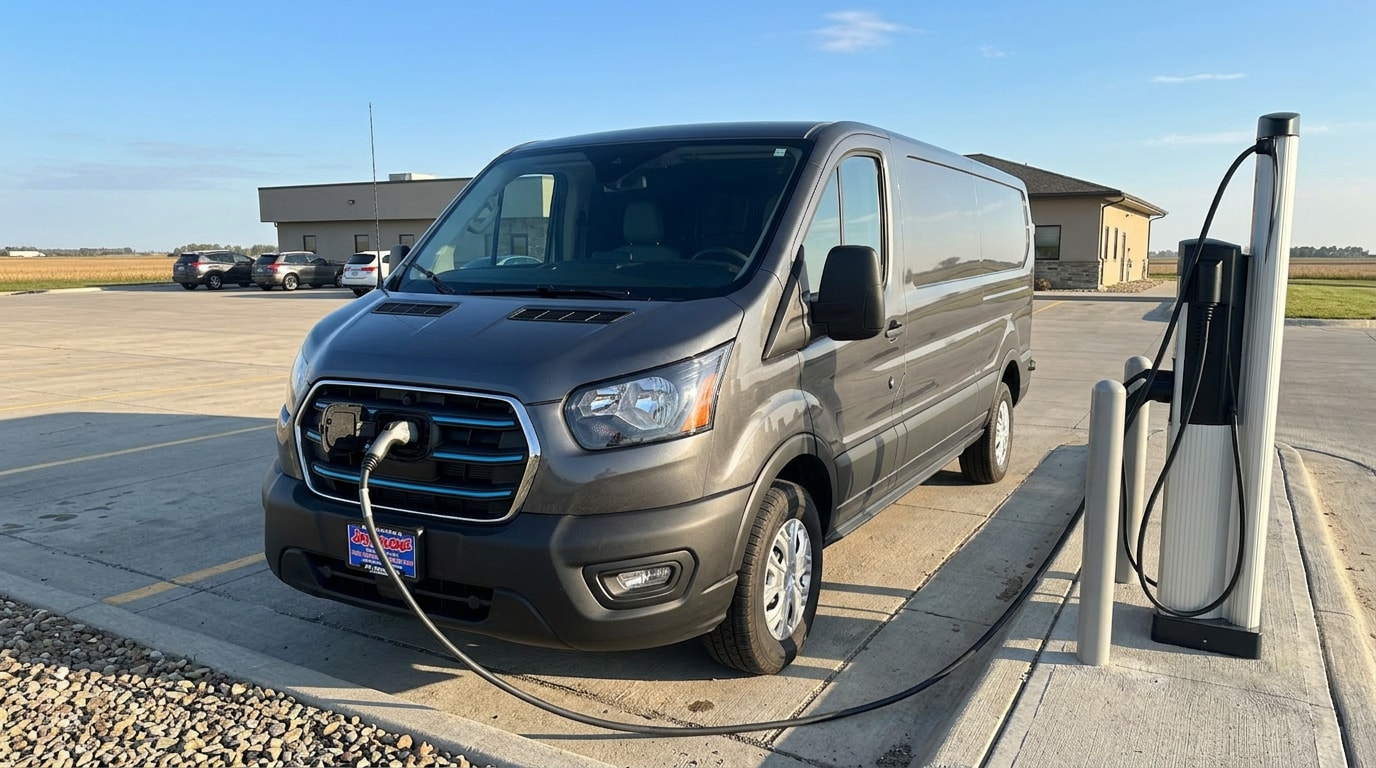
The 2026 Ford Transit® gives buyers three meaningfully different powertrains: the standard 3.5L PFDi V6 gas (275 hp / 260 lb-ft, naturally aspirated, 10-speed SelectShift® automatic), the optional 3.5L EcoBoost® V6 gas (310 hp / 400 lb-ft, twin-turbo, also 10-speed automatic), or the fully electric E-Transit™ (89 kWh High-Voltage Battery, 266 hp / 317 lb-ft, up to 159 miles estimated range, DC fast charging at up to 115 kW). The 2026 model year brings expanded EcoBoost availability (no longer requires Ambulance Prep on low/medium roof RWD Cargo Vans), Single Onboard Charger now standard on E-Transit, Vapor Injection Heat Pump now standard for cold-weather efficiency, and E-Transit availability expanded to 156-inch wheelbase Chassis Cab/Cutaway. This guide walks through each powertrain in detail, the gas vs. electric decision framework for central Minnesota business, when each engine fits which application, and the 2026-specific changes worth knowing.
On This Page
Quick-reference summary before the deep dives:
The big-picture takeaway: the PFDi gas is the most affordable and works well for most general Transit applications. The EcoBoost adds substantial low-RPM torque for heavy loads, AWD operation, and high-roof configurations. The E-Transit is the right answer for local-route delivery operations with overnight depot or home charging. Each engine fits specific use cases — the right answer depends on what you’re actually doing with the van.
The 3.5L PFDi V6 (engine code 998) is the standard gas engine across most Transit configurations. “PFDi” stands for Port-Fuel/Direct-Injection — a hybrid fuel-delivery system that combines port injection (at lower loads) with direct injection (at higher loads). The result is good fuel economy at light loads and strong performance under heavier loads. Naturally aspirated — no turbocharger.
Specs:
Where it shines:
Where it’s less ideal:
Best fit: XL Cargo Van for fleet operations, light-cargo delivery, courier service, mobile detailing, mobile pet services, small-load mobile service, smaller trade operations carrying modest tool inventory, RWD operations not requiring AWD capability.
2026 change: Flex Fuel capacity has been removed from the 3.5L PFDi engine. Buyers who previously used E85 ethanol blends with PFDi-equipped Transits will need to use standard gasoline for 2026 model year.
The 3.5L EcoBoost V6 (engine code 99G) is the twin-turbocharged upgrade option. Same 3.5L displacement as the PFDi but with twin turbochargers and direct injection. The result is substantially more horsepower and dramatically more torque, particularly in the meaningful low-to-mid RPM range where commercial vans actually operate.
Specs:
Where it shines:
Where it’s less ideal:
Best fit: Passenger Van XL and XLT (standard), all T-350 HD variants (standard), high-roof Cargo Vans (standard), AWD Cargo Vans (required), heavy-load trade operations (Electrician, HVAC, General Contractor), commercial body upfit, towing operations, mobile service operations running heavier equipment, fleet operators wanting maximum capability margin.
2026 change: the 3.5L EcoBoost V6 is now available on low/medium roof Cargo Vans with RWD (configurations E1Y, R1Y, W1Y, F1Y, E1C, R1C, W9C, F7C) without requiring the Ambulance Prep Package (47B). Previously, the EcoBoost was tied to Ambulance Prep on these configurations — meaning buyers who wanted the EcoBoost had to add the Ambulance Prep Package even if they had no intent to convert to an ambulance. The 2026 change uncouples them. Substantial expansion of EcoBoost availability for buyers wanting more torque without the Ambulance Prep tie-in.
The E-Transit is the fully electric Transit variant. Same fundamental chassis architecture as the gas Transit but with the engine and transmission replaced by an 89 kWh High-Voltage Battery pack (mounted under the floor) and a rear-mounted electric motor.
Specs:
Where it shines:
Where it’s less ideal:
Best fit: local-route last-mile delivery, fixed-route fleet operations with depot charging, urban/suburban delivery operations, mobile service routes with predictable mileage, businesses with sustainability goals and federal tax credit access, applications where quiet operation is valued.
2026 E-Transit updates:
The Transit’s drivetrain decision is straightforward but worth understanding:
RWD (Rear-Wheel Drive) — standard on all Transit configurations.
AWD (Intelligent All-Wheel Drive) — available with gas engines.
Practical guidance for central MN: if your operation requires year-round access to customers in any weather, AWD is worth the option cost. For trades, service operations, and delivery operations that must reach customers in winter conditions, the AWD’s confidence is real. For urban delivery operations primarily on plowed paved roads, RWD with appropriate winter tires is plenty. For E-Transit buyers needing AWD, gas EcoBoost is the alternative.
Both gas engines (PFDi and EcoBoost) pair with the Ford 10-speed SelectShift automatic transmission. Same fundamental transmission across the gas Transit lineup — tuned slightly differently to match each engine’s torque curve.
10-speed SelectShift features:
The 10-speed pairs especially well with the EcoBoost. The wide spread of the EcoBoost’s torque curve (peak torque available from about 2,500 RPM up through redline) combined with 10 closely-spaced gears means the engine stays in its peak torque zone under load almost continuously — very different from older transmissions where you’d feel the engine fall off torque between shifts.
E-Transit transmission: the E-Transit’s electric motor delivers power through a single-speed gear reduction — no multi-speed transmission needed because the electric motor produces full torque from zero RPM. The result is immediate, smooth acceleration without any shift events.
Fuel tank options (gas engines):
Alternator options:
Battery options (gas engines):
E-Transit charging (no engine alternator/battery in traditional sense):
Engine Block Heater (400W Rating) available on gas engines. Strongly recommended for buyers parking outside in central MN winters. Plug in for 2-3 hours before starting to get the engine to operating temperature faster, reduce wear on cold starts, and have cabin heat available sooner.
For buyers choosing between gas Transit and E-Transit, here’s the practical framework we walk through:
What’s your typical daily mileage?
Do you have access to overnight charging?
Do you need AWD?
Do you tow regularly?
How long do you plan to keep the vehicle?
Quick rule of thumb for central MN business: if you have predictable local-route operations under 100 miles per day, dedicated overnight charging access, and don’t require AWD, the E-Transit pays back through lower operating costs and tax credits. For everything else — long routes, unpredictable mileage, AWD needs, no charging access, heavy towing — gas Transit is the more flexible answer.
Some specific MN factors worth thinking through:
Cold-weather electric range. E-Transit’s 159-mile range is a maximum — expect a 20-30% reduction at sub-zero MN winter temperatures. Real-world expectation: 100-130 miles in deep winter, 130-160 miles in milder conditions. The new 2026 Vapor Injection Heat Pump improves cold-weather efficiency vs. previous E-Transit generations (uses less battery energy to heat the cabin), but doesn’t eliminate cold-weather range loss. Plan accordingly.
Diesel fuel infrastructure in central MN. Standard #2 diesel is widely available throughout central MN at major fuel stations along Highway 7, US-12, and MN-15. The Transit doesn’t use diesel (gas only, plus E-Transit electric), so this isn’t a Transit-specific concern. For commercial buyers cross-shopping diesel options (Mercedes Sprinter), this is part of the comparison.
Long highway runs. The Hutchinson-to-Twin Cities commute, Hutchinson-to-Sauk Centre, or any extended highway run is where gas Transit’s flexibility matters. Operations that include occasional long routes (parts runs, courier service to outlying areas, large delivery jobs) benefit from gas’s range and flexibility.
AWD for rural service. For service operations reaching customers on rural gravel roads in McLeod, Meeker, or Renville counties, AWD is genuinely useful. Available with EcoBoost. Particularly valuable in spring when frost heaves and mud make rural unmaintained roads difficult.
Engine Block Heater. Strongly recommended for buyers parking outside in winter (very common in central MN). Gets the engine to operating temperature faster, reduces wear on cold starts, and gets cabin heat available sooner. 400W rating, plug in for 2-3 hours before starting.
E-Transit charging infrastructure in central MN. DC fast charging is available at major stations along the I-94 and I-35 corridors and at certain locations along Highway 7 and US-12. For E-Transit buyers planning local-route operations, install a dedicated Level 2 charger at your depot or home rather than relying on public charging. Public DC fast charging is for occasional supplemental charging, not daily refueling.
Federal tax credits for E-Transit. The E-Transit may qualify for federal commercial electric vehicle tax credits. Consult your accountant or tax advisor for specifics on your business’s qualifying conditions and credit availability.
Specific buyer profiles based on conversations on the Hutchinson sales floor:
The electrical contractor with full Trade Package upfit. 3.5L EcoBoost V6. The additional torque pairs better with loaded operation, the Dual Alternator option matters for jobsite electrical loads, and the EcoBoost is well-suited to AWD configurations for rural service work.
The local-route last-mile delivery operation with depot charging. E-Transit. Lower fuel costs, lower maintenance costs, federal tax credits, and quiet operation for residential delivery. Vapor Injection Heat Pump (standard for 2026) handles MN winter efficiency.
The HVAC contractor running rural service. 3.5L EcoBoost V6 with AWD. Rural MN service work requires AWD; HVAC equipment loads require the EcoBoost’s torque.
The mobile mechanic with custom upfit. 3.5L EcoBoost V6 with Dual Alternator option. Multiple electrical loads (work lights, air compressor, tools) want the additional alternator capacity.
The fleet operator running couriers in town. 3.5L PFDi V6 typically. Lighter cargo loads, predictable routes, lowest acquisition cost. RWD is fine for paved urban routes.
The school district running activity transport. 3.5L EcoBoost V6 (standard on Passenger Van). The torque matters for loaded crew transport with 12-15 passengers.
The hotel or airport shuttle operator. 3.5L EcoBoost V6 (standard on Passenger Van XLT). Comfortable highway cruising with passenger loads.
The body builder installing a service body. 3.5L EcoBoost V6 (standard on T-350 HD configurations). The HD GVWR and EcoBoost torque pair with the additional service body weight.
The recreational camper van enthusiast. 3.5L EcoBoost V6 with AWD (often). The torque and AWD capability matter for camping at off-grid locations and reaching adventure destinations.
The light-cargo courier or parts delivery service. 3.5L PFDi V6. Light loads, predictable routes, lowest cost.
The local food and grocery delivery operation. E-Transit (with depot charging) or 3.5L PFDi V6 (without). Local routes with predictable mileage are good E-Transit candidates.
The plumbing contractor with service body on Chassis Cab. 3.5L EcoBoost V6. Service body weight plus tools and materials wants the torque.
The landscaping operation with dump body. 3.5L EcoBoost V6 on T-350 HD configuration. Dump body weight plus loaded soil, mulch, or debris benefits from the EcoBoost’s torque.
The refrigerated delivery operation. 3.5L EcoBoost V6 with Dual Alternator on Cutaway. The refrigeration unit’s electrical load wants the dual alternator capacity; the loaded weight wants the EcoBoost’s torque.
The motorhome conversion buyer. 3.5L EcoBoost V6 on Cutaway. Motorhome conversion weight wants the EcoBoost torque for highway cruising.
The fleet operator running E-Transit pilot. E-Transit Cargo Van or Cutaway. Many central MN businesses are running E-Transit pilots to evaluate fit before committing larger fleet conversions — the pilot vehicle establishes range, charging infrastructure needs, and operational fit.
Key Takeaways
Depends on use. For light-cargo applications, predictable routes, RWD operation, and operations where the PFDi’s 260 lb-ft is plenty, the EcoBoost upgrade is harder to justify. For heavier loads, AWD operation, high-roof configurations, towing applications, Passenger Van or T-350 HD configurations (where EcoBoost is standard anyway), and buyers wanting maximum capability margin, the EcoBoost is meaningfully better. The 400 lb-ft of torque (vs 260 on PFDi) makes a real difference in daily driving under load. For most central MN trade and service applications, the EcoBoost pays back through better acceleration, less downshifting under load, and more comfortable highway cruising.
For the operations it fits, yes — through lower fuel costs (electricity costs less than gasoline per mile), lower maintenance costs (no oil changes, no transmission services, fewer wear items), and federal tax credits where applicable. The payback math depends on annual mileage, your electricity rates, your local fuel prices, and your maintenance costs. For local-route operations putting on 15,000-30,000 miles per year with consistent charging access, the E-Transit typically pays back within 3-5 years on total cost of ownership. For longer routes or operations without charging infrastructure, it doesn’t pay back. The fit matters more than the math — if it’s the right operation, the numbers work; if it’s the wrong operation, no amount of math fixes the range or charging infrastructure problem.
Depends on the charger. At a DC fast charger (up to 115 kW), you can add substantial range in 30-45 minutes — useful for occasional supplemental charging during the day. At a Level 2 home or depot charger (10.5 kW max with single onboard charger), full charge from empty takes approximately 8-12 hours. At a standard 120V outlet, charging is impractically slow for daily commercial use. For practical operations, you need Level 2 charging at your depot or home — plan for installation costs of $500-$2,500 per charger depending on electrical service upgrades needed. The dual onboard charger option (65C) allows faster Level 2 charging when supported by your charger infrastructure.
On older model years, the EcoBoost was bundled with the Ambulance Prep Package on certain low/medium roof RWD Cargo Van configurations — even for buyers who had no intent to convert to an ambulance. Ford’s 2026 update uncouples them: the EcoBoost is now available on those configurations (E1Y, R1Y, W1Y, F1Y, E1C, R1C, W9C, F7C) without requiring Ambulance Prep. Substantial improvement for buyers wanting the EcoBoost upgrade without the Ambulance Prep tie-in. The EcoBoost was always available on high-roof, AWD, Passenger Van, and T-350 HD configurations without Ambulance Prep — the 2026 change adds availability to the low/medium roof RWD Cargo Van configurations that were previously tied to Ambulance Prep.
Technically yes, but range loss is substantial. The E-Transit’s electric motor produces strong torque (317 lb-ft from a standstill), which actually makes it good at launching loads from a stop. The problem is electric range under load — towing dramatically reduces battery range, often by 40-50% or more depending on trailer weight and aerodynamics. For occasional light towing within range constraints, E-Transit can do it. For regular towing or heavier loads, gas Transit (especially EcoBoost) is the more practical answer. Maximum Transit tow rating is 4,500 lbs with the Heavy-Duty Trailer Tow Package — substantially less than heavy-duty pickups, but adequate for smaller trailers (equipment trailers, smaller cargo trailers, side-by-side trailers).
The Single Onboard Battery Charger (standard for 2026) supports Level 2 charging at up to 10.5 kW — meaning the Level 2 charger you plug into can deliver up to 10.5 kW to the vehicle. The Dual Onboard Battery Chargers option (65C) supports faster Level 2 charging when paired with a compatible higher-capacity Level 2 charger. For most fleet operations and overnight depot charging, the Single Charger is sufficient — you have all night to charge. For operations needing faster mid-day charging or operations with limited overnight charging windows, the Dual Charger option provides flexibility. DC fast charging speed (up to 115 kW) is not affected by the onboard charger option — DC fast charging bypasses the onboard chargers entirely.
A Vapor Injection Heat Pump is a more efficient cabin heating system than traditional resistive heating (which converts battery electricity directly to heat). The heat pump uses refrigerant to move heat from outside air or other vehicle systems into the cabin — same fundamental technology as a home heat pump. The advantage: it uses significantly less battery energy to produce the same amount of cabin heat. For E-Transit operation in MN winters, this matters a lot — cabin heating is one of the biggest factors in cold-weather electric range loss. The 2026 E-Transit’s standard Vapor Injection Heat Pump improves cold-weather efficiency vs. previous E-Transit generations that used less efficient heating. Doesn’t eliminate cold-weather range loss, but reduces it meaningfully.
If you’ve narrowed in on the right powertrain, the next step is choosing body style, model series, configuration, and packages. Come down to our Hutchinson showroom on Highway 7 and we’ll walk through the full build. Bring your routes, your typical loads, your charging infrastructure plans (if E-Transit), and your fleet needs — we’ll spec the right Transit for your operation.
If we don’t have your exact configuration in stock, we’ll either pull one from another dealer at no extra charge or place a factory order through Ford. Same price either way — that’s how we’ve operated since 2005.
About the Author
I’m Jordan Malone-Forst, Assistant General Manager at Jay Malone Motors in Hutchinson, MN. I’m proud to be part of the family business my dad Jay started in 2005 — and even prouder to serve the community I grew up in. When I’m not at the dealership, you’ll find me involved with the Hutchinson Ambassadors and Chamber of Commerce. If you have questions about any Ford vehicle or want to talk through your options, reach out — I’d love to help.