

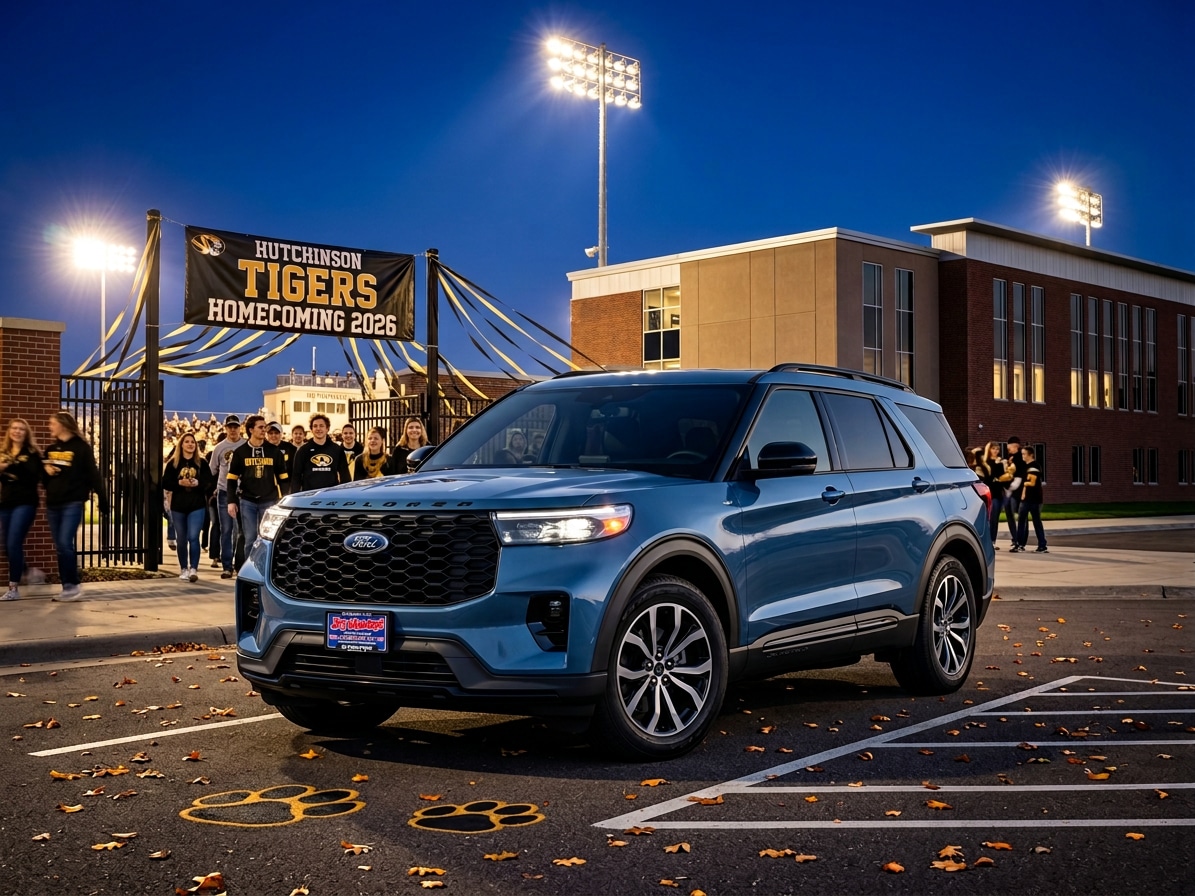
For families in central Minnesota, the SUV purchase is one of the most consequential vehicle decisions you’ll make. You need it to haul kids to hockey practice in Willmar on a January morning. You need it to fit grandparents for the lake trip to Dassel. You need cargo space for hockey bags, strollers, and the weekend gear that doesn’t fit in a two-row SUV. And you need all of that without sacrificing the winter traction and daily reliability that Minnesota roads demand.
The 2026 Ford Explorer® is built around exactly that use case — and its seating and cargo system is more configurable than most buyers realize before they walk into the showroom. This guide covers everything you need to know about the Explorer’s family space: how many people it seats, how the second and third rows actually work in real life, what captain’s chairs vs bench seat means for your family, and how the cargo numbers translate to actual usability.
In This Guide
- How many people does the 2026 Explorer seat?
- Captain’s chairs vs bench seat — which is right for your family?
- What is the third row like in the Explorer?
- How do the PowerFold® third-row seats work?
- How much cargo space does the Explorer have?
- What are the interior dimensions of the 2026 Explorer?
- How does seating differ by Explorer trim?
- Can the Explorer tow a boat or camper for a Minnesota family?
- How to pick the right Explorer seating configuration
- Key Takeaways
- Frequently Asked Questions
How Many People Does the 2026 Ford Explorer Seat?
The 2026 Ford Explorer seats either 6 or 7 passengers depending on the second-row configuration you choose. This is a genuine choice — not a trim-level restriction in most cases — and it’s one of the first decisions you should make when configuring your Explorer.
- 6-passenger configuration: Second-row captain’s chairs with a center walkthrough. Easier third-row access. More comfortable for second-row passengers. Standard on Active Base, Active, Tremor®, and Platinum™.
- 7-passenger configuration: Second-row 35/30/35 split bench. Fits three across in the middle row. Standard on ST-Line. New standalone option on ST 4WD for 2026. Reduces second-row comfort but adds a full passenger seat.
The practical difference matters more than the number. Families with three kids in car seats or boosters often find the bench makes daily life easier — three kids fit across the middle without anyone climbing over. Families who use the third row occasionally and prioritize second-row passenger comfort tend to prefer the captain’s chairs. We’ll break this decision down in full below.
Captain’s Chairs vs Bench Seat — Which Is Right for Your Family?
This is the most common seating question we get from Explorer buyers at Jay Malone Ford — and the answer genuinely depends on how you use the vehicle day to day. There is no universally right answer. Here’s how to think through the decision:
| Captain’s Chairs (6-passenger) | 35/30/35 Bench (7-passenger) | |
|---|---|---|
| Third-row access | ✅ Easy center walkthrough without moving second-row seats | ⚠ Requires folding or tilting a seat section to access third row |
| Second-row comfort | ✅ Individual seats with armrests — more comfortable for adults | ⚠ Bench seating — less individual comfort, especially for center seat |
| Second-row passenger count | 2 passengers | ✅ 3 passengers — fits three car seats/boosters across |
| Total vehicle seating | 6 passengers | 7 passengers |
| Best for | Families of 4–6 who use the third row regularly; adults riding second row; buyers who value easy third-row access | Families with 3 kids who all need the middle row; buyers who need maximum passenger count; carpooling families |
| Available on | Active Base, Active, Tremor®, Platinum™ (standard); ST (with bench not selected) | ST-Line (standard); ST 4WD (new standalone option for 2026) |
The scenario I hear most at the dealership: A family of five — two adults, three kids — where two of the kids are in car seats. The bench seat puts all three kids across the middle row, which makes loading and unloading much faster than buckling two kids in the second row and one in the third. For that family, the bench is often the right call even though the captain’s chairs are more comfortable for adult passengers.
The scenario where captain’s chairs win: A family of four or five where the third row is used for occasional extra passengers — grandparents on road trips, cousins on the lake run — but the second row is where adults sit most of the time. The walkthrough access makes getting into the third row seamless, and the individual armrests make the drive more comfortable for second-row adults on longer trips to the Cities or up to Brainerd.
What Is the Third Row Like in the 2026 Explorer?
The third row in the Explorer is a genuine seat — not a jump seat. That said, it’s important to be honest about what the third row is comfortable for, because this is an area where expectations sometimes don’t match reality.
Third-row dimensions:
| Measurement | Third Row | Second Row (for comparison) |
|---|---|---|
| Head room | 38.9” | 40.5” |
| Leg room | 31.8” | 37.5” |
| Shoulder room | 54.6” | 61.9” |
| Hip room | 40.9” | 59.1” |
The honest assessment: the Explorer’s third row is comfortable for kids up through middle-school age for most trips. Teenagers and adults can fit, but it’s best suited for shorter trips or occasional use for adults. The 31.8” of leg room is meaningful — comparable to many two-row compact SUVs — and the 38.9” of head room accommodates most passengers without feeling pinched.
Real-world third-row use for central MN families: Kids going to Glencoe for a game in the back row, grandparents on a Saturday trip to Waconia, cousins on a lake run — these are exactly what the Explorer’s third row is built for. If you need adults in the third row for a long highway drive to the Cities, they’ll fit, but it’s a tighter seat than many adults expect. Sit in it before you decide if that use case matters to you.
How Do the PowerFold® Third-Row Seats Work?
PowerFold® seats are one of the most practically useful features in the Explorer for families who regularly switch between passenger mode and cargo mode. Instead of physically folding down a heavy third-row seat by hand — which usually requires crawling into the cargo area — PowerFold® lets you collapse the third row flat at the push of a button, either from inside the vehicle or via the power liftgate controls.
PowerFold® third-row seat availability by trim:
- Active Base (100A): Manual fold — no PowerFold®
- Active (200A): Manual fold — no PowerFold®
- ST-Line (300A): Manual fold — no PowerFold®
- Tremor® (800A) with 2.3L: PowerFold® Flat available via Convenience Package (68G)
- Tremor® (800A) with 3.0L: PowerFold® Flat included in Ultimate Package (standard with 3.0L)
- ST (400A): PowerFold® standard
- Platinum™ (600A): PowerFold® standard
For families who regularly transition from seven-passenger to cargo mode — loading after a hockey tournament, packing for a lake weekend, hauling groceries for a large family — PowerFold® makes a noticeable difference in daily convenience. If the third row is going down more than twice a week, it’s worth moving up to a trim that includes it.
Practical note: The PowerFold® on the Explorer is a full flat fold — when the third row is down, the cargo floor is a continuous flat surface from the liftgate all the way to the second-row seats. This makes loading bulky gear significantly easier than a partial fold.
How Much Cargo Space Does the 2026 Explorer Have?
The Explorer’s cargo numbers are strong for the three-row segment — and more importantly, they’re usable in the configurations that most families actually need day to day.
| Configuration | Cargo Volume | What It Holds |
|---|---|---|
| Behind 3rd row (all passengers seated) | 16.3 cu ft | Grocery run, 2–3 hockey bags, a stroller, or a small haul |
| Behind 2nd row (3rd row folded) | 46.0 cu ft | Full team’s hockey gear, camping equipment for 4, large appliance boxes |
| Behind 1st row (both rows folded, RWD) | 85.8 cu ft | Moving furniture, large gear hauls, full family road trip with serious luggage |
| Behind 1st row (ST, Platinum™, Tremor® 4WD) | 85.3 cu ft | Same practical use — minimal difference from RWD figure |
The 16.3 cu ft behind the third row is the number that matters most for everyday use. It’s a meaningful space — enough for a week’s worth of groceries, a double stroller, or the gear you need for a family day trip. It’s not a cavernous cargo hold, but it’s genuinely usable for families who keep the third row up most of the time.
The 46.0 cu ft behind the second row is where the Explorer really opens up. This is the configuration most families use on road trips and haul days — third row down, second row occupied, cargo area full. It comfortably handles full hockey equipment for a team of kids, camping gear for a family of four, or the kind of general-purpose hauling that comes up regularly in rural Minnesota life.
Load-in height note: The lift-in height varies slightly by trim — 31.1” on RWD models, 31.3” on standard 4WD, 31.9” on the ST, and 32.3” on the Tremor® (which sits higher due to off-road suspension). This is a practical consideration for families who regularly load heavy items or car seats — a lower load floor is easier on your back over time.
Floor length detail: The floor length behind the third row is 20.8”, behind the second row is 49.8”, and behind the first row is 84.1” of flat load floor. That 84.1” is long enough to lay a standard 4x8 sheet of plywood in flat with the tailgate down — useful context for the Minnesota buyer who needs an occasional utility haul from the lumber yard.
What Are the Interior Dimensions of the 2026 Explorer?
Here’s the full interior dimension picture for the 2026 Explorer to help you visualize the space before you sit in it:
| Dimension | First Row | Second Row | Third Row |
|---|---|---|---|
| Head room | 40.7” | 40.5” | 38.9” |
| Leg room | 43.0” | 37.5” | 31.8” |
| Shoulder room | 62.1” | 61.9” | 54.6” |
| Hip room | 59.2” | 59.1” | 40.9” |
The Explorer’s wheelbase is 119.1” and overall length is 198.7” — a size that fits comfortably in most standard garages and parking structures while still delivering genuine three-row family space. The first and second-row dimensions are genuinely roomy for adults. The third row is honest family use territory for kids and occasional adult passengers.
How Does Seating Differ by Explorer Trim?
Not all Explorer trims offer the same seating options — and the differences go beyond captain’s chairs vs bench. Here’s a full picture of how seating varies across the lineup:
| Trim | 2nd Row Config | 2nd Row Heated | 3rd Row Fold | Seating Material |
|---|---|---|---|---|
| Active Base 100A | Captain’s chairs (6) | ❌ | Manual | Cloth |
| Active 200A | Captain’s chairs (6) | ❌ (opt. via 68A: ActiveX™) | Manual | Cloth / ActiveX™ opt. |
| ST-Line 300A | 35/30/35 bench (7) std | Outboard opt. (68L) | Manual | Cloth with red stitching |
| Tremor® 800A | Captain’s chairs (6) | ✅ Heated 2nd row std | PowerFold® opt. (68G) / std (3.0L) | Miko® suede/vinyl |
| ST 400A | Captain’s chairs std; bench opt. (4WD) | ❌ std | PowerFold® std | Miko® perforated with red stitching |
| Platinum™ 600A | Captain’s chairs (6) | ✅ Heated 2nd row std | PowerFold® std | ActiveX® with perforated leather inserts |
For families who want heated second-row seats as standard — genuinely useful for Minnesota winters when kids are climbing into a cold vehicle — the Tremor® and Platinum™ are the trims where it comes included. ST-Line buyers can add heated outboard second-row positions via the Premium Package (68L). The full trim picture and what each model includes is covered in our 2026 Explorer trim comparison guide.
Can the Explorer Tow a Boat or Camper for a Minnesota Family?
Yes — and this is one of the practical advantages of the Explorer over smaller three-row SUVs. Every 2026 Explorer includes the Class III Trailer Tow Package as standard equipment, which provides a Class III weight-carrying hitch receiver rated for up to 5,000 lbs of towing when properly equipped.
What 5,000 lbs of towing covers for central Minnesota family use:
- Most pontoon boats under 20 feet with a standard trailer
- Bass boats, fishing boats, and smaller ski boats
- Snowmobile trailer with two sleds
- Small to mid-size utility trailers for landscaping or hauling
- Pop-up campers and lightweight travel trailers under 5,000 lbs loaded
- ATVs and recreational equipment trailers
Important for RV and camper buyers: The Explorer is NOT capable of flat towing (four-down or dinghy towing) behind a motorhome. Both RWD and 4WD Explorer vehicles will cause transmission damage if flat towed with all four wheels on the ground. If you need to tow your Explorer behind a larger RV, a flatbed carrier is required. This is a confirmed OEM restriction — not a matter of opinion or trim level.
The towing package includes a 7-pin wiring harness and 4/7-pin connector for trailer lighting and brake controller connections. Side-Wind Stabilization and Trailer Sway Control are standard on all Explorer models to help manage trailer behavior in crosswinds — a practical feature for central Minnesota buyers who tow on US-7 and MN-15 in open country conditions.
One honest framing for truck buyers considering the Explorer: If you regularly haul livestock trailers, grain carts, or heavy equipment trailers, the Explorer’s 5,000 lb max is a meaningful limitation. The Explorer is a family SUV first — for heavy towing duty in central MN, the F-150 is the right vehicle. The Explorer shines for the boat-to-the-lake, camper-for-the-weekend use case that many Minnesota families need.
How to Pick the Right Explorer Seating Configuration
Here’s a practical decision framework for Explorer seating based on real family scenarios:
- Count your regular passengers first. If you regularly carry 6 or fewer people, captain’s chairs work for your use case. If you regularly need 7 seats — three kids plus adults — the bench is the answer.
- Think about how often the third row goes down. If the third row is folded more than twice a week, PowerFold® is worth moving up for. It’s standard on ST and Platinum™, optional on Tremor® via the Convenience Package.
- Consider who rides second row. If adults ride second row regularly, captain’s chairs with the center walkthrough are meaningfully more comfortable. If it’s kids every day and adults occasionally, the bench gives you the extra seat count when you need it.
- Evaluate your towing needs. If the lake boat or snowmobile trailer is a regular part of summer and winter life, the Explorer’s 5,000 lb standard towing covers most Minnesota recreational towing needs without any add-ons.
- Factor in heated second-row seats for Minnesota winters. If you want that as standard, Tremor® and Platinum™ include it. If you’re on ST-Line, add the Premium Package.
The full trim and equipment picture for the 2026 Explorer is covered in our 2026 Ford Explorer complete overview at Jay Malone Ford.
Key Takeaways
- The 2026 Explorer seats 6 (captain’s chairs) or 7 (35/30/35 bench) — a genuine choice that depends on your family’s daily use
- ST-Line comes with the bench as standard; Active Base, Active, Tremor®, and Platinum™ come with captain’s chairs standard; ST offers both
- Third-row leg room is 31.8” — comfortable for kids, workable for adults on shorter trips
- Cargo behind the third row: 16.3 cu ft — a genuine usable space for everyday grocery and gear runs
- Cargo behind the second row: 46.0 cu ft — where the Explorer really opens up for haul and travel use
- PowerFold® third-row seats are standard on ST and Platinum™; optional on Tremor® (Convenience Package); manual fold on Active Base, Active, and ST-Line
- Heated second-row captain’s chairs standard on Tremor® and Platinum™; optional on ST-Line via Premium Package
- Max towing: 5,000 lbs standard on all trims via Class III Tow Package — covers most Minnesota recreational towing needs
- Explorer CANNOT be flat towed — use flatbed carrier if towing behind an RV
Frequently Asked Questions
Does the 2026 Ford Explorer have 3 rows of seating?
Yes — the 2026 Ford Explorer has three rows of seating standard across all trim levels. It seats 6 passengers with second-row captain’s chairs or 7 passengers with the 35/30/35 bench seat. The third row is a genuine seat with 38.9” of head room and 31.8” of leg room.
How much cargo space does the 2026 Explorer have?
The 2026 Explorer offers 16.3 cu ft of cargo space behind the third row with all passengers seated, 46.0 cu ft behind the second row with the third row folded, and up to 85.8 cu ft behind the first row with both rows folded flat. The floor length behind the first row is 84.1 inches.
Does the Explorer have PowerFold third-row seats?
PowerFold® third-row seats are standard on the Explorer ST and Platinum™. They are available on the Tremor® via the Convenience Package (68G) on 2.3L models and included in the Ultimate Package on 3.0L Tremor® models. The Active Base, Active, and ST-Line all have manual-fold third-row seats.
Can the 2026 Ford Explorer seat 7 passengers?
Yes — with the 35/30/35 second-row bench seat, the Explorer seats 7 passengers. The bench seat is standard on the ST-Line and available as a standalone option on the ST 4WD (new for 2026). Captain’s chairs are standard on Active Base, Active, Tremor®, and Platinum™, which seat 6.
How much can the 2026 Explorer tow?
The 2026 Explorer tows up to 5,000 lbs when properly equipped. The Class III Trailer Tow Package is standard on all trim levels — no additional package is required. This covers most Minnesota recreational towing including pontoon and fishing boats, snowmobile trailers, pop-up campers, and light utility trailers. Max tongue load is 500 lbs.
Can the Explorer be flat towed behind a motorhome?
No — the 2026 Ford Explorer is not capable of flat towing (also called four-down or dinghy towing). Towing an Explorer with all four wheels on the ground behind a motorhome will cause transmission damage. If you need to move your Explorer behind a larger RV, use a flatbed carrier. This applies to both RWD and 4WD Explorer models.
My Take on Explorer Family Space
The question I get asked most often by Explorer buyers at Jay Malone Ford is whether the third row is “really usable.” My honest answer: for kids, yes — genuinely, not just technically. For adults on longer trips, it depends on how long and how often. The Explorer’s third row is one of the more comfortable in the class for the kids it’s most commonly used for.
The captain’s chairs vs bench decision is the one I spend the most time on with buyers. Sit in both before you decide. The walkthrough access on the captain’s chairs changes the daily experience meaningfully for families with little kids in car seats who need to be buckled into the third row. The bench changes it differently when three kids need the middle row every morning.
If you want to see the Explorer’s seating configurations in person — sit in the third row, load a stroller into the cargo area, walk through the captain’s chair access — come see us at Jay Malone Ford in Hutchinson. That fifteen minutes in the showroom tells you more than any spec sheet.
About the Author
I’m Jordan Malone-Forst, Assistant General Manager at Jay Malone Motors in Hutchinson, MN. I’m proud to be part of the family business my dad Jay started in 2005 — and even prouder to serve the community I grew up in. When I’m not at the dealership, you’ll find me involved with the Hutchinson Ambassadors and the Hutchinson Area Chamber of Commerce. If you have questions about the Explorer’s seating or want to come sit in one, reach out — I’d love to help.