💵
Value My Car → We Buy Cars — Even If You Don’t Buy From Us.
Get a real offer on your vehicle in minutes. No obligation, no pressure.


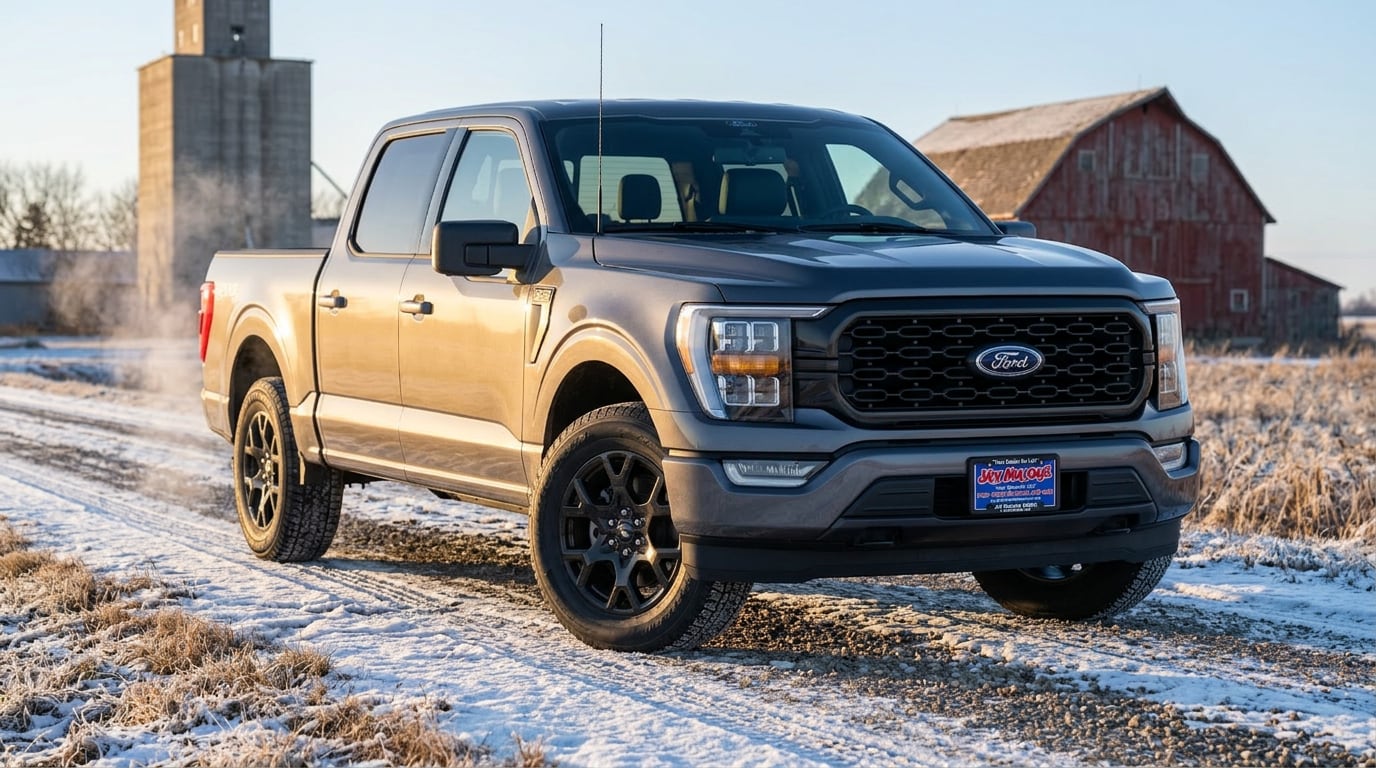
If you drive an F-150 around Hutchinson, you have probably noticed your truck no longer goes by the old “every 3,000 miles” rule. Newer F-150s tell you when they need an oil change through the Intelligent Oil-Life Monitor — and here in central Minnesota, that interval comes up sooner than most owners expect. Here is what Ford actually recommends, and why a McLeod County winter changes the math.
Quick Answer
Ford’s Intelligent Oil-Life Monitor decides when your F-150 needs an oil change based on how you drive — up to a maximum of one year or 10,000 miles, whichever comes first. But Ford also says short trips, cold temperatures, idling in traffic, and towing all count as severe driving conditions, which shorten that interval. A typical Minnesota winter checks several of those boxes at once, so many local F-150s should be serviced more often than the 10,000-mile ceiling suggests. When the oil-change message appears, get it done within two weeks or 500 miles.
On this page
Your F-150 determines its own oil-change schedule through the Intelligent Oil-Life Monitor, and Ford’s hard limit is one year or 10,000 miles, whichever comes first. You should never exceed that. In practice, though, very few trucks around here actually reach 10,000 miles between changes — because the way we drive in central Minnesota shortens the interval.
Here is how the real-world numbers break down for an F-150:
| Situation | Ford’s Guidance |
|---|---|
| Maximum between oil changes | 1 year or 10,000 miles, whichever comes first |
| After the oil-change message appears | Service within 2 weeks or 500 miles |
| If the monitor resets early or stops working | Change at 6 months or 5,000 miles from the last change |
| Severe driving conditions (see below) | Follow the shorter severe-service schedule |
The takeaway: don’t treat 10,000 miles as your target. Treat it as the absolute ceiling, and let the truck — and your driving conditions — tell you when it’s really time.
The Intelligent Oil-Life Monitor is Ford’s system for tracking your oil’s condition based on how you actually use the truck, rather than a fixed mileage countdown. It watches factors like engine temperature, trip length, idle time, and load, then displays a message in the instrument cluster when an oil change is due. That means you don’t have to remember a mileage number — the truck does the math for you.
A few things worth knowing as an owner. When the message appears, change the oil within two weeks or 500 miles. After every oil and filter change, the monitor needs to be reset — if you have it serviced here, we reset it for you. And if the display ever resets on its own or stops working, fall back to a 6-month or 5,000-mile schedule so you’re never running blind.
Because Ford specifically lists cold weather and short trips as severe driving conditions — and a Hutchinson winter delivers both. When you drive under severe conditions, Ford directs you to follow the shorter severe-service schedule, not the standard one.
Here is what Ford counts as severe driving, straight from the F-150 owner’s manual:
Now picture a typical winter week here: a five-minute drive to work in below-zero cold, letting the truck warm up in the driveway, a run down a gravel road, maybe pulling a trailer on the weekend. That’s three or four severe-condition boxes checked at once. The cold itself is hard on oil — short trips don’t let the engine fully warm up, which lets fuel and moisture dilute the oil instead of burning off. Over a Minnesota winter, that adds up fast. It’s the single biggest reason we tell local F-150 owners not to stretch their intervals.
For the gas F-150 engines — the 2.7L EcoBoost, 3.5L EcoBoost, 3.5L PowerBoost hybrid, and 5.0L V8 — Ford specifies Motorcraft SAE 5W-30 motor oil. Using an oil that meets Ford’s specification and viscosity grade isn’t optional fine print: the manual warns that the wrong oil can cause component damage your warranty won’t cover, longer cranking, and reduced fuel economy.
Ford also advises against pouring in aftermarket oil additives — they’re unnecessary and can lead to engine damage that isn’t covered. When you service with us, we use the correct Motorcraft oil and filter for your specific engine, so there’s no guesswork.
Oil capacity depends on which engine is under the hood. Here are the figures from Ford for the current F-150 gas engines, including the filter:
| Engine | Oil Capacity (with filter) | Oil Type |
|---|---|---|
| 2.7L EcoBoost V6 | 6.0 quarts | Motorcraft 5W-30 |
| 3.5L EcoBoost V6 | 6.0 quarts | Motorcraft 5W-30 |
| 3.5L PowerBoost Full Hybrid V6 | 6.0 quarts | Motorcraft 5W-30 |
| 5.0L V8 | 7.75 quarts | Motorcraft 5W-30 |
One note for the do-it-yourselfers: don’t fill past the maximum mark on the dipstick. Ford warns that overfilling above the maximum can cause engine damage, so if you’re topping off, add a little at a time and recheck.
In most winters, no — Motorcraft 5W-30 is the correct year-round oil for the F-150. But Ford does offer guidance for genuinely extreme cold: when the ambient temperature reaches minus 22°F (minus 30°C) or below, Ford recommends switching to a SAE 0W-30 oil that meets its specification to improve cold-start performance.
We do see stretches that cold in this part of Minnesota. If you’re parking outside through a deep cold snap, or you regularly start the truck at high altitude in sub-zero temperatures, it’s worth a conversation when you come in. We’ll tell you honestly whether the 0W-30 makes sense for how and where you drive — we’re not going to upsell you on something your truck doesn’t need.
An oil change is also the right moment to catch small things before they become winter breakdowns. Ford pairs the oil-change interval with a set of inspections, and our technicians follow that checklist every time. At each oil-change interval, Ford recommends:
That brake, coolant, and battery-area check matters more than it sounds before a Minnesota winter — it’s how you find a marginal battery or thin brake pads in November instead of on a frozen morning in January.
Both can change your oil, but there are real reasons to bring an F-150 to a Ford dealer. We use the correct Motorcraft oil and filter matched to your exact engine, our technicians are trained specifically on Ford trucks, we reset the Intelligent Oil-Life Monitor properly, and the genuine Ford parts we install carry a nationwide 24-month parts-and-labor limited warranty. We also keep your service records, which helps protect resale value when you trade.
There’s also a hometown reason. We’re a family-owned shop here in Hutchinson, and we’ve been voted Best Auto Mechanic in town. We treat your truck the way we’d treat our own — and if your F-150 doesn’t actually need something, we’ll tell you.
For folks right here in Hutchinson, we also offer pickup and delivery on service — we’ll come get your F-150 and bring it back when it’s done, so an oil change doesn’t cost you a trip across town. Just ask when you schedule.
Key Takeaways
Follow the Intelligent Oil-Life Monitor and never exceed one year or 10,000 miles. Because Minnesota winters involve cold temperatures and short trips — both of which Ford classifies as severe driving — most local F-150 owners will reach an oil change sooner than the 10,000-mile maximum. When the cluster message appears, service within two weeks or 500 miles.
The gas F-150 engines — 2.7L EcoBoost, 3.5L EcoBoost, 3.5L PowerBoost hybrid, and 5.0L V8 — all use Motorcraft SAE 5W-30 motor oil that meets Ford’s specification. Ford recommends against using aftermarket oil additives.
It depends on the engine. The 2.7L EcoBoost, 3.5L EcoBoost, and 3.5L PowerBoost hybrid each hold 6.0 quarts with the filter, while the 5.0L V8 holds 7.75 quarts with the filter.
It means the Intelligent Oil-Life Monitor has determined your oil is due for replacement. Change the oil and filter within two weeks or 500 miles of the message appearing, and make sure the monitor is reset afterward — we handle the reset for you when you service with us.
In most conditions, standard Motorcraft 5W-30 is correct year-round. When temperatures reach minus 22°F (minus 30°C) or below, Ford recommends switching to an approved SAE 0W-30 oil to improve cold-start performance. Ask us whether it makes sense for how you drive.
Yes — we offer service pickup and delivery for customers in Hutchinson. We’ll come get your F-150, service it, and bring it back. Just let us know when you schedule your appointment.
Bottom line: your F-150 is built to tell you when it needs oil, but a Minnesota winter means you shouldn’t wait for the 10,000-mile ceiling. Keep an eye on that cluster message, lean toward the shorter severe-service side through the cold months, and you’ll get the most life out of your truck. If you’re not sure where your truck stands, bring it in — we’ll take a look and give it to you straight. — Brady Forst, Service Manager
About the Author
I’m Brady Forst, Service Manager at Jay Malone Ford in Hutchinson, MN. I lead our service team and spend my days making sure local trucks and SUVs are ready for whatever a Minnesota season throws at them. My goal is always to keep your Ford running right and to give you honest, straightforward advice — never a sales pitch. If you have a question about your F-150 or want to schedule service, come see us — we’re happy to help.